

Table of Contents
 Set as a preferred Google source
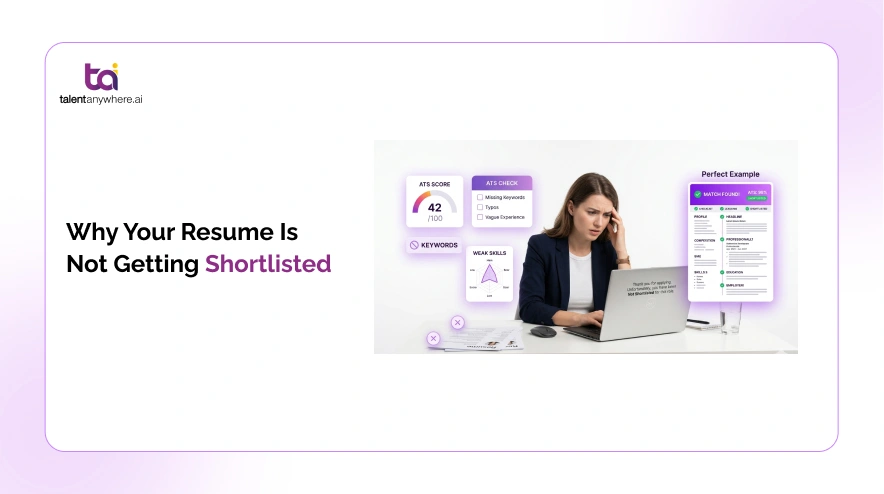
You’ve applied to multiple jobs, but your resume isn’t getting shortlisted.
This isn’t random.
The modern hiring process is highly automated, and most resumes are filtered out before a recruiter even sees them. Today, over 98% of Fortune 500 companies use Applicant Tracking Systems (ATS) to screen candidates, meaning your resume is first evaluated by software—not a human (source).
This changes how resumes need to be written.
It’s no longer enough to simply list your experience. Your resume must be structured in a way that both machines and recruiters can understand quickly. If it fails at either stage, it won’t get shortlisted.
This guide breaks down exactly why resumes get rejected and how to fix each issue with practical, proven strategies.
What Happens After You Submit Your Resume?
Understanding this process changes how you approach resume writing.
Stage 1: ATS Screening
ATS scans your resume for:
- Keywords
- Skills and tools
- Job title relevance
- Formatting compatibility
If your resume doesn’t match these criteria, it gets filtered out.
Stage 2: Recruiter Scan
If you pass ATS, a recruiter reviews your resume quickly.
They look for:
- Relevant experience
- Clear impact
- Easy-to-scan structure
If your resume doesn’t show value within seconds, it is skipped.
Why Your Resume Is Not Getting Shortlisted
1. Your Resume Is Not ATS-Friendly
Why This Happens
ATS systems cannot properly read:
- Tables
- Columns
- Icons or graphics
- Complex templates
Instead of structured data, your resume appears broken or incomplete.
What This Causes
- Missing skills in ATS scan
- Misinterpreted experience
- Automatic rejection
Fix
- Use single-column layout
- Add standard headings (Experience, Skills, Education)
- Keep formatting simple and text-based
2. Your Resume Doesn’t Match How ATS Understands Keywords
Most candidates misunderstand how keywords work.
Why This Happens
ATS evaluates:
- Exact keyword match
- Context and placement
- Frequency
Example:
Job requires:
“SEO Strategy, Technical SEO, Google Analytics”
Your resume says:
“Worked on SEO”
This results in low relevance.
What This Causes
- Low ATS score
- Poor ranking among applicants
Fix
- Mirror job description language
- Add keywords inside achievements
- Use keyword variations
Example
Weak Example:
- Responsible for SEO
Strong Example:
- Led SEO strategy, increasing organic traffic by 45% using technical SEO audits and Google Analytics
3. You’re Sending the Same Resume Everywhere
Why This Happens
Candidates use one generic resume for multiple roles.
ATS compares resumes directly with job descriptions — not broadly.
What This Causes
- Low match score
- Weak positioning vs competitors
Fix
Customize only what matters:
- Summary
- Skills
- Top experience points
Example
Same experience:
- SEO Manager → strategy, leadership
- SEO Executive → execution, tools
4. Your Resume Talks About Work — Not Impact
4. Your Resume Talks About Work — Not Impact
Why This Matters
Recruiters don’t evaluate responsibilities — they evaluate results.
Most candidates list what they did, not what they achieved.
What This Causes
- Generic resume
- Low differentiation
- Reduced recruiter interest
Fix
Use:
Action + Task + Result
Examples
Weak Example:
- Managed social media
Strong Example:
- Increased engagement by 60% through targeted campaigns
Weak Example:
- Worked on SEO
Strong Example:
- Improved organic traffic by 40% via technical SEO optimization
5. Poor Readability and Structure
Why This Happens
Dense content makes scanning difficult.
What This Causes
- Recruiters skip your resume
- Key achievements go unnoticed
Fix
- Use bullet points
- Keep sentences concise
- Maintain clean formatting
6. Resume Length Issues
Why This Happens
- Too long → hard to scan
- Too short → lacks depth
Fix
- Freshers: 1 page
- Experienced: 1–2 pages
7. Errors and Inconsistencies
Why This Matters
Even small mistakes affect credibility.
Fix
- Proofread thoroughly
- Ensure consistency in formatting and dates
How ATS Actually Reads Your Resume
Most candidates don’t understand this — and it’s a major reason for rejection.
ATS converts your resume into structured data and evaluates:
- Job titles
- Skills
- Keywords
- Experience timeline
Important Insight
If your resume uses:
- Icons
- Graphics
- Columns
ATS may:
- Skip important sections
- Misread information
- Ignore key achievements
Result
A visually attractive resume can still fail technically.
Read More – Top 10 AI Recruitment Tools
The 7-Second Resume Test
Recruiters typically spend less than 10 seconds reviewing a resume.
They check:
- Job relevance
- Skills
- Measurable impact
If these are not immediately visible, your resume is rejected.
How to Fix Your Resume (Step-by-Step)
Most advice tells you what to do. This shows you how to actually do it correctly.
Step 1: Fix Your Resume Format for ATS Compatibility
Even strong resumes fail if they cannot be read properly.
What You Should Do
- Use single-column layout
- Use standard headings
- Choose readable fonts (Arial, Calibri)
- Save in PDF or .docx
Avoid
- Tables
- Icons
- Complex designs
Quick Test
Paste your resume into a plain text editor. If it breaks, ATS will struggle too.
Step 2: Align Your Resume with the Job Description
This step directly impacts your shortlist chances.
What You Should Do
- Identify primary and secondary keywords
- Add them across:
- Summary
- Skills
- Experience
Example
Instead of:
- Google Ads
Write:
- Managed Google Ads campaigns, improving ROI by 32%
Step 3: Rewrite Bullet Points to Show Impact
This is where most resumes fail.
What You Should Do
Use:
Action + Task + Result
Example
Weak Example:
- Handled email marketing
Strong Example:
- Increased email open rates by 25% through targeted campaigns
Step 4: Customize for Each Role (Without Rewriting Everything)
What You Should Do
Update:
- Summary
- Skills
- Top achievements
Why This Works
It improves ATS match and recruiter relevance instantly.
Step 5: Improve Readability for the 7-Second Scan
What You Should Do
- Keep bullets short
- Use spacing
- Highlight metrics
Your resume should be scannable in seconds.
Step 6: Validate and Test Your Resume Before Applying
Most candidates skip this — and keep getting rejected.
What You Should Do
- Compare with job description
- Check keyword coverage
- Review structure
Instead of guessing, use a tool.
talentanywhere.ai helps you:
- Identify keyword gaps
- Detect ATS issues
- Improve structure
- Optimize for specific roles
This removes guesswork and improves results.
Step 7: Proofread and Eliminate Errors
What You Should Do
- Check grammar
- Ensure consistency
- Verify details
Even small errors can cost you shortlisting.
Resume Optimization Checklist
Before applying, ensure your resume:
- Is ATS-friendly
- Matches job keywords
- Shows measurable results
- Has clear structure
- Is error-free
- Is tailored for the role
Why Resume Optimization Matters in 2026
Hiring is more competitive than ever.
- Most resumes never reach recruiters
- Only 2–3% of applicants get shortlisted
Small improvements can significantly increase your chances.
Stop Guessing Why Your Resume Is Failing
Most candidates apply to dozens of jobs without knowing what’s wrong.
That leads to repeated rejection.
Before applying again, ask:
- Is your resume ATS-friendly?
- Does it match the job role?
- Are you highlighting impact clearly?
This is where talentanywhere.ai helps.
It gives you:
- Clear insights
- Actionable fixes
- Role-specific recommendations
Instead of guessing, you fix what actually matters.
Conclusion
If your resume is not getting shortlisted, it’s not luck.
It’s driven by:
- ATS compatibility
- Keyword alignment
- Structure and clarity
- Demonstrated impact
Each of these can be improved.
Instead of applying blindly, focus on optimizing your resume based on how hiring systems actually work.
Tools like talentanywhere.ai help you identify and fix issues faster. Try talentanywhere.ai today!
FAQs
Why is my resume not getting shortlisted?
How do I make my resume ATS-friendly?
What is a good ATS score?
How can I improve my resume quickly?


talentanywhere.ai
Build professional resumes with AI, improve your ATS score, and apply with confidence. talentanywhere.ai empowers job seekers with smarter resume creation and career tools for every stage.