

Table of Contents
 Set as a preferred Google source
Every job application seems to ask for the same two things: a resume and, sometimes, a cover letter. Yet a surprising number of applicants either send both without knowing why, skip the cover letter and hope it does not matter, or reuse one document as a stand in for the other. The confusion between a cover letter vs resume is common, and it often costs candidates a chance to make a stronger first impression. Understanding the difference between cover letter and resume, and knowing exactly when each one is needed, can make your application easier to write and more effective to read.
This guide breaks down what each document is for, how they differ in purpose and format, and when a cover letter genuinely helps your chances in the Indian job market.
What Is a Resume
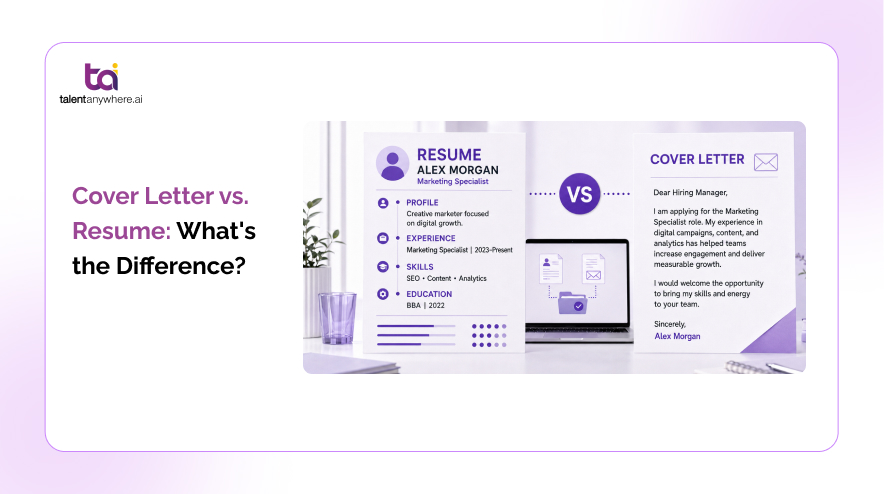
A resume is a concise, structured summary of your professional background. It lists your work experience, education, skills, and relevant achievements in a scannable format, usually one to two pages long. Recruiters and hiring managers use it to quickly check whether your qualifications match the role.
A resume’s job is to answer one question: what have you done, and are you capable of doing this job? It relies on bullet points, clear section headers, and measurable results rather than narrative explanation. Most applicant tracking systems also scan resumes for keywords, which is why format and structure matter as much as content.
What Is a Cover Letter
A cover letter is a short, personalized letter that accompanies your resume. Instead of listing facts, it explains in your own words why you are applying, why you are a good fit for the specific role, and what you bring that a list of bullet points cannot fully capture.
Where a resume shows, a cover letter tells. It gives you room to connect your background to the company’s needs, address anything unusual in your career path, such as a gap or a career switch, and show genuine interest in the role rather than a generic application sent to dozens of companies at once.
Also Read More How to Make a Perfect Resume
Key Differences Between a Cover Letter and Resume
The easiest way to see the difference between cover letter and resume is side by side.
| Aspect | Resume | Cover letter |
| Purpose | Shows what you have done | Explains why you are the right fit |
| Length | One to two pages | Three to four short paragraphs |
| Format | Structured, bullet driven | Written as a letter, addressed to the employer |
| Content | Facts, skills, achievements | Personal story tied to the specific role |
| Tone | Factual, standardized | Personalized, conversational but professional |
Beyond the table, a few dimensions are worth understanding in more depth.
Purpose
A resume proves capability. It is a record of what you have already accomplished, structured so a recruiter can judge your fit in a matter of seconds. A cover letter builds the case for why that capability matters for this particular job at this particular company. One documents the past, the other makes the argument for the future.
Length and Format
A resume is dense and scannable, built around headings, bullet points, and short phrases rather than full sentences. A cover letter reads like a short business letter, typically three to four paragraphs: an opening that states the role and your interest, a middle that connects your experience to what the employer needs, and a closing that invites the next step.
Content and Focus
A resume lists what you did and the outcomes you drove, project by project or role by role. A cover letter narrows the focus to what matters most for this specific application. Instead of repeating your entire work history, it picks two or three relevant points and builds a short, coherent story around them.
Tone and Personalization
A resume follows a fairly standardized tone across applications, since the same document is often submitted to multiple employers with minor edits. A cover letter should not be reused as is. It is addressed to a specific employer, mentions the specific role, and reads as though it was written for that one opportunity, even if the underlying template is similar.
Also Read More Best Resume Formats to Use
When Do You Need Each
A resume is essentially non negotiable. Almost every job application in India expects one, and without it your candidacy usually cannot be considered at all.
A cover letter is more situational. For many roles in India, especially at the entry level or in high volume hiring processes, a cover letter is optional and recruiters may not read it closely, if at all. That does not mean it is pointless. A cover letter is worth writing when the job posting explicitly asks for one, when you are applying to a smaller company or a role where a direct application to a hiring manager is possible, when you are changing industries or explaining a gap and need space to give context a resume cannot, or when the role is competitive enough that a thoughtful cover letter can help you stand out from applicants with similar resumes.
If none of these apply and the employer has not asked for one, a strong resume alone is usually enough. When in doubt, a short, well written cover letter rarely hurts and can occasionally be the deciding factor.
Not sure if your application needs a cover letter?
Let talentanywhere.ai help you figure it out
Resume vs CV Explained
A related source of confusion is resume vs CV. In most of the world, a CV, short for curriculum vitae, is a longer and more detailed document than a resume. It is common in academic, research, and medical fields, and can run to several pages, covering publications, presentations, grants, and a full teaching or research history.
In India, however, the terms resume and CV are frequently used interchangeably in everyday hiring conversations and job postings, especially outside academia. When an Indian job listing asks for a CV, it almost always means the same one to two page resume format described earlier, not the longer academic document used elsewhere. It is still useful to know the distinction, since it will matter if you are applying abroad or to an academic or research position where a genuine CV is expected.
Also Read More Why Your Resume Is Not Getting Shortlisted
How to Use Your Cover Letter and Resume Together
The two documents work best when they are treated as a pair rather than duplicates of each other.
Tailor both to the specific role rather than sending a generic version to every employer. Use the cover letter to add context and motivation, not to restate your resume in paragraph form. Keep formatting, fonts, and contact details consistent across both documents so your application feels put together rather than assembled from mismatched parts. Finally, make sure the cover letter references specifics about the company or role, since a letter that could be sent to any employer defeats its own purpose.
Common Mistakes to Avoid
A few mistakes come up repeatedly, and all of them are easy to fix once you are aware of them.
The most common is repeating the resume word for word in the cover letter, which wastes the one advantage a cover letter has: the chance to add something new. A close second is sending a generic, unedited cover letter that clearly was not written for the specific role. Some applicants attach a cover letter even when the employer only asked for a resume, which is usually harmless but occasionally signals a lack of attention to instructions. And typos or inconsistent formatting in either document can undo an otherwise strong application, so a careful proofread of both is worth the extra few minutes.
Conclusion
A resume and a cover letter do different jobs. The resume proves what you have done, and the cover letter explains why it matters for this specific role. Knowing when a cover letter is expected, and when a strong resume alone will do, saves time and helps you put effort where it counts. If you are building or refining either document, talentanywhere.ai’s tools are designed to help job seekers put together resumes and applications that are clear, complete, and ready to send. Register Today!
FAQs
What is the main difference between a cover letter and a resume?
Do I need a cover letter with my resume in India?
Is a CV the same as a resume?
Should a cover letter repeat my resume?
What comes first, the cover letter or the resume?


talentanywhere.ai
Build professional resumes with AI, improve your ATS score, and apply with confidence. talentanywhere.ai empowers job seekers with smarter resume creation and career tools for every stage.