

Table of Contents
 Set as a preferred Google source
AI interviews have gone from an experiment at a handful of large employers to something most job seekers will run into during a search. In the US, 63% of job seekers say they have already experienced an AI interview, up 13 percentage points in just six months, according to the Greenhouse 2026 Candidate AI Interview Report. Whether you are a candidate preparing for your next AI job interview, or a hiring team deciding whether to bring AI into first-round screening, it helps to understand what an AI interview actually is, how it works, and where its limits are.
What is an AI interview
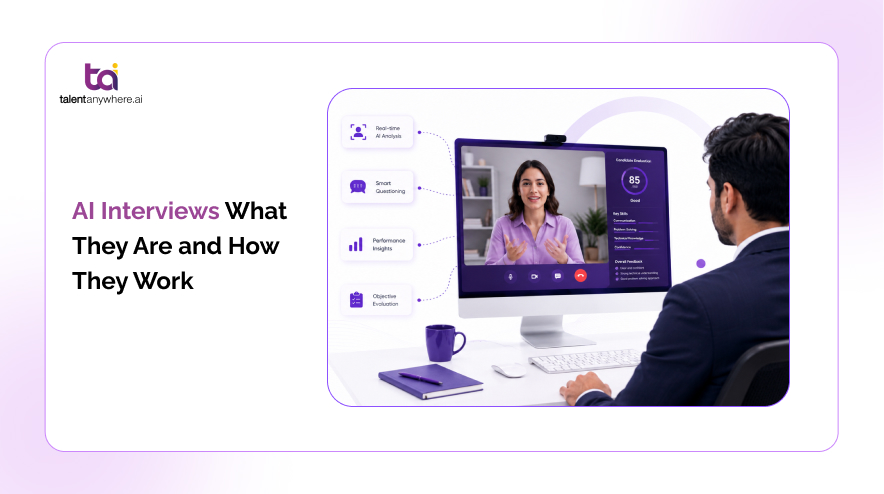
An AI interview is a hiring conversation, live or recorded, where artificial intelligence asks the questions, evaluates the answers, or both, in place of or alongside a human interviewer. Some AI interviews are fully automated: a candidate records responses to preset questions on their own time, and an algorithm scores the answers before a recruiter ever sees them. Others are semi-automated, where AI supports a human interviewer by generating questions, transcribing the conversation, or scoring responses in real time while a person still leads the discussion. What ties these formats together is that a machine, not a human alone, is doing some or all of the evaluation work that used to sit entirely with a recruiter or hiring manager.
How do AI interviews work
Most AI interviews follow a similar sequence regardless of the vendor or format. A candidate is invited to a session, either scheduled or on-demand, and answers a set of questions tied to the role. The system then processes what was said and, in video formats, how it was said, before generating a score or summary that a recruiter uses to decide who moves forward.
AI video and avatar interviews
In a typical video-based AI interview, the candidate records answers to preset questions through their webcam and microphone, often with no live person on the other end. Some platforms use an on-screen AI avatar or chatbot to ask follow-up questions and keep the conversation adaptive, adjusting the next question based on how the candidate answered the last one. These sessions can happen at any time that suits the candidate, which is one reason employers use them heavily for high-volume, early-stage screening.
What the AI evaluates
Once a response is recorded, natural language processing analyzes the content of the answer, including relevance, structure, and keyword alignment with the job description. Speech analysis looks at tone, pace, and confidence in how the answer was delivered. Some tools also apply computer vision to track facial expressions, eye contact, and body language, though a growing number of vendors have scaled this back due to fairness and legal concerns. The output is typically a score or a shortlist recommendation, which a recruiter reviews before deciding who advances. For a broader look at the platforms doing this work, see our guide to AI recruitment tools.
Also Read: Top 12 Job Portals in India for Recruiters & Job Seekers
Types of AI interviews
AI interviews are not a single format. The main types in use today are:
- Asynchronous video interviews: candidates record answers to preset questions on their own schedule, and AI scores the responses before a recruiter reviews them.
- AI chatbot or avatar interviews: a conversational AI asks questions through text or voice, often used for initial screening at scale.
- Live AI-assisted interviews: a human interviewer leads the conversation while AI transcribes, analyzes tone and language, and surfaces insights in real time.
- AI-scored assessments layered onto human interviews: the interview itself is conducted by a person, but AI reviews the recording afterward to flag key themes or concerns for the hiring team.
Walk into your AI interview already prepared
Get instant feedback on clarity, pacing, and content, the same signals AI interviewers score.
Benefits of AI interviews
AI interviews exist because they solve real, practical problems on both sides of the hiring table, even as they introduce new ones.
For hiring teams
The clearest benefit is speed at scale. A single recruiter cannot personally interview thousands of applicants for a high-volume role, but an AI system can screen all of them on a consistent set of questions within days. Consistency is the other draw: every candidate answers the same questions under the same conditions, which reduces the variability that comes from different interviewers having different styles and standards.
For candidates
AI interviews can also work in a candidate’s favor. On-demand formats let people interview on their own schedule instead of coordinating time zones or taking time off work. Structured, consistent questions mean candidates are not at the mercy of an interviewer having an off day. Interestingly, candidate reaction is not uniformly negative.
Limitations and fairness considerations
The gap between how employers and candidates experience AI interviews is significant, and it centers on trust rather than the technology itself. Only 26% of US candidates believe most employers are using AI responsibly and transparently, per the Greenhouse 2026 Candidate AI Interview Report. That same report found 70% of candidates were never clearly told upfront that AI would be evaluating them, and 38% have walked away from a hiring process specifically because it included an AI interview.
Communication gaps compound the trust problem. Among candidates who completed an AI interview, 51% never received an outcome at all, according to Greenhouse’s data. Bias remains an open concern too: candidates in the same report flagged similar rates of perceived age and race bias from AI interviewers as from human ones, which suggests AI has not yet solved the fairness problems it was meant to fix, and in some cases has simply scaled them. For hiring teams, this means AI interviews are not a shortcut around fair, structured hiring practices. They still need clear disclosure, defined evaluation criteria, and a human in the loop for decisions that affect someone’s livelihood.
What AI interviews mean for candidates
For job seekers, AI interviews change what preparation looks like without changing why preparation matters. The fundamentals, knowing your own experience cold and structuring answers clearly, still carry the interview. What is different is that AI systems reward directness and relevant keywords more than a human interviewer might, and they cannot read a room the way a person can, so nervous energy or an offbeat sense of humor may not land the way it would with a live interviewer. Speaking clearly, answering the question that was actually asked, and avoiding filler words all tend to help, since these are the same signals both AI and human interviewers are listening for. Building strong material to draw on in the first place still matters just as much; see how AI enhanced resumes are helping candidates get more callbacks before they even reach the interview stage. For more structured preparation, our roundup of interview preparation books is a good place to start.
talentanywhere.ai takes this further by letting candidates practice the format itself before it counts. Our mock AI interview tool mirrors the same scoring criteria real AI interviewers use, and gives instant feedback on clarity, pacing, and answer structure so candidates walk in already comfortable with the format instead of encountering it cold for the first time in a real screening. Paired with our AI job search platform, candidates get support that spans the whole journey, from finding the right role to being genuinely ready for the interview that follows.
Practice your next AI interview before it counts
Run a mock AI interview and see exactly how you’re being scored.
What AI interviews mean for hiring teams
For recruiters and hiring managers, the calculus is about where AI adds real value versus where it adds risk. AI interviews are strongest early in the funnel, where the goal is narrowing a large pool to a manageable shortlist using consistent, defined criteria. They are weakest as a final decision-maker, where nuance, culture fit, and context that a candidate cannot always convey through a screen matter most. Getting this right increasingly depends on where automation sits inside the broader recruiting stack, including how interview data connects to the rest of the AI recruiter tools a team already relies on. Disclosure is not optional in practice either. Candidates are actively watching for it, and 57% believe employers should be legally required to disclose when AI is being used in hiring, per Greenhouse’s report. Teams that get ahead of that expectation, rather than waiting for regulation to force it, tend to protect their employer brand along with their hiring outcomes.
Also Read: Why Recruitment Teams Need a Better Interview Management System
How talentanywhere.ai supports AI interviews
talentanywhere.ai brings structure to AI-assisted interviewing so hiring teams get the speed benefits without losing sight of the candidate experience. The platform supports both asynchronous video screening and live, AI-assisted interviews, giving hiring teams a way to standardize questions, keep human reviewers in the loop on every decision, and give candidates clear visibility into where AI is used and what it is evaluating. For teams building out an AI interview avatar for structured screening, our interviewer assessment capability is built specifically for that use case, pairing consistent question sets with recruiter-reviewed scoring rather than automated rejections.
For candidates, talentanywhere.ai works from the other side of the same problem. Instead of encountering an AI interview for the first time when it actually matters, job seekers can run a mock AI interview through the platform, built to mirror the same criteria real AI interviewers score against, and get direct feedback on tone, pacing, and content before the real conversation. Combined with the AI job search platform, this means talentanywhere.ai supports fairness and preparation on both sides of the interview, not just for the teams doing the hiring.
Screen every candidate consistently. Decide every hire personally.
AI handles the first pass. Your team still makes the call.
Conclusion
AI interviews are not a passing trend. They are quickly becoming the default first step in hiring, and that is true whether you are the one asking the questions or the one answering them. The technology handles volume and consistency well, but it still depends on clear disclosure, defined criteria, and a human making the final call to work fairly. Understanding how AI interviews work, what they evaluate, and where their limits are is what turns an unfamiliar format into a manageable one, for candidates preparing to face one and for hiring teams deciding how to build one.
Whether you are getting ready for your next AI interview or building a fairer, faster one for your hiring pipeline, talentanywhere.ai is built to support both sides. Practice a mock AI interview here as a candidate, or see how automated screening works for hiring teams. Try talentanywhere.ai today.
FAQs
Are AI interviews accurate and fair?
How should I prepare for an AI interview?
Do AI interviews replace human recruiters?
talentanywhere.ai Blog
Build professional resumes with AI, improve your ATS score, and apply with confidence. talentanywhere.ai empowers job seekers with smarter resume creation and career tools for every stage.