



Table of Contents
 Set as a preferred Google source
Your best candidate just withdrew. Not because of salary. Not because of the role. Because it took four days, six emails, and two reschedules just to lock in a first-round interview slot.
By the time your team confirmed the panel, they had already accepted an offer elsewhere.
This is not a sourcing problem. It is an interview management problem, and it is far more common than most HR leaders realise.
Most recruitment technology investment goes into applicant tracking systems. ATS platforms do their job well at the top of the funnel: job posting, application collection, resume screening, and pipeline tracking. But the ATS largely stops being useful the moment a candidate moves to the interview stage. What happens next, scheduling, coordination, feedback collection, and candidate communication, is often held together by email threads, calendar invites, and shared spreadsheets.
That gap is exactly where great candidates are lost.
This article breaks down what an interview management system actually is, the signs your current process is costing you candidates, and what the right platform should be doing for your hiring team.
See How talentanywhere.ai Manages the Full Interview Lifecycle
Automated scheduling, structured kits, centralised feedback — all in one platform.
What Is an Interview Management System?
An interview management system (IMS) is a dedicated platform that manages everything that happens after a candidate clears initial screening. Where an ATS tracks applications and manages the hiring pipeline at a high level, an IMS manages the operational and experiential layer of the interview process itself.
Here is a simple way to think about the distinction:
“`html
| ATS | Interview Lifecycle Management Platform |
|---|---|
| Tracks applications and pipeline stages | Manages scheduling, panels, and slots |
| Stores candidate profiles | Delivers structured interview kits to interviewers |
| Manages job postings | Collects and centralises interviewer feedback |
| Handles offer letters | Sends automated reminders and candidate communications |
| Tracks hiring status | Provides real-time visibility on where every candidate stands |
An ATS tells you that a candidate is in the interview stage. An Interview Lifecycle Management platform actually runs that stage with structure, speed, and consistency.
The two are not competitors. In mature hiring operations, they work together. But for teams relying solely on their ATS to manage interviews, significant gaps in process quality, candidate experience, and hiring speed are almost inevitable.
Signs Your Interview Process Is Costing You Candidates
Before looking at solutions, it helps to recognise the symptoms. If any of the following sound familiar, your interview process is likely leaking candidates and creating friction that shows up in your time-to-hire and offer acceptance rates.
Scheduling takes too many back-and-forth emails
The cost of slow scheduling is measurable. According to Cronofy’s 2024 Candidate Expectations Report, which surveyed 12,000 candidates across 7 countries, 42% of candidates dropped out of a hiring process because it took too long to schedule an interview.
Getting three interviewers and one candidate aligned on a 45-minute slot should not take four days. But in organisations without automated scheduling, that is frequently what happens. Each email introduces a delay. Each delay increases the risk that the candidate moves forward with another employer or simply disengages.
Interviewers walk in unprepared
When interview kits, role-specific question sets, and evaluation criteria are not delivered in advance, interviewers fall back on improvised conversations. This produces inconsistent assessments, a poor signal on candidate quality, and a weaker overall interview experience for everyone involved.
Feedback is inconsistent or arrives too late
If feedback collection depends on individual interviewers remembering to fill out a form or reply to an email, the quality and timeliness of that feedback will vary enormously. Delayed or missing feedback slows down decisions and can hold up an entire hiring cycle.
No visibility on where candidates stand
The hiring manager emails the recruiter. The recruiter messages the interviewer. The interviewer forgot to submit feedback three days ago. Meanwhile, the candidate has been waiting.
When hiring managers, recruiters, and interviewers are all working from different sources of truth, gaps appear. Candidates fall through the cracks. Duplicate conversations happen. Follow-up communications get missed. The experience looks disorganised from the outside because it is disorganised on the inside.
Candidate experience feels transactional
Candidates are evaluating your organisation throughout the interview process. If communication is slow, rescheduling is painful, or they receive no update after a round, they draw conclusions about your culture and operational quality. For senior or high-demand candidates, a poor interview experience is often enough to influence their final decision.
10 Key Benefits of Using an Interview Management System
Here is what a purpose-built interview management system actually delivers for recruitment teams, framed around outcomes rather than features.
1. Faster time-to-hire
When scheduling is automated, feedback collection is structured, and workflows remove manual coordination steps, the entire interview cycle compresses. Roles that previously took three to four weeks to fill can move significantly faster. For high-demand roles where top candidates are typically off the market within a week or two, that speed difference directly affects the quality of your eventual hire.
2. Reduced interviewer bias and more consistent evaluations
Standardised interview kits, preset scoring rubrics, and structured question sets ensure every candidate is evaluated against the same criteria, regardless of which interviewer conducts the session. This reduces gut-feel decisions, improves the signal-to-noise ratio in hiring data, and supports broader DEI commitments by introducing objectivity into a stage that is historically vulnerable to unconscious bias.
3. Less administrative burden on recruiters
According to GoodTime’s 2026 Hiring Insights Report, recruiters spend 38% of their time on interview scheduling alone more than sourcing, screening, or any other single activity. That is more than a third of a recruiter’s workweek going toward calendar management rather than candidate relationships or strategic hiring work.
Automated reminders, self-scheduling links, rescheduling workflows, and feedback nudges take repetitive coordination work off the recruiter’s plate. Instead of spending hours managing calendar logistics and chasing interviewers for feedback, recruiters can focus on candidate relationships, hiring manager alignment, and strategic sourcing.
4. Better candidate experience
Self-scheduling gives candidates flexibility and control. Timely communication reassures them that their application is being handled professionally. A well-structured interview process sends a signal about how the company operates. For competitive roles and senior hires, the interview experience often influences whether a candidate accepts an offer, even when other factors are equal.
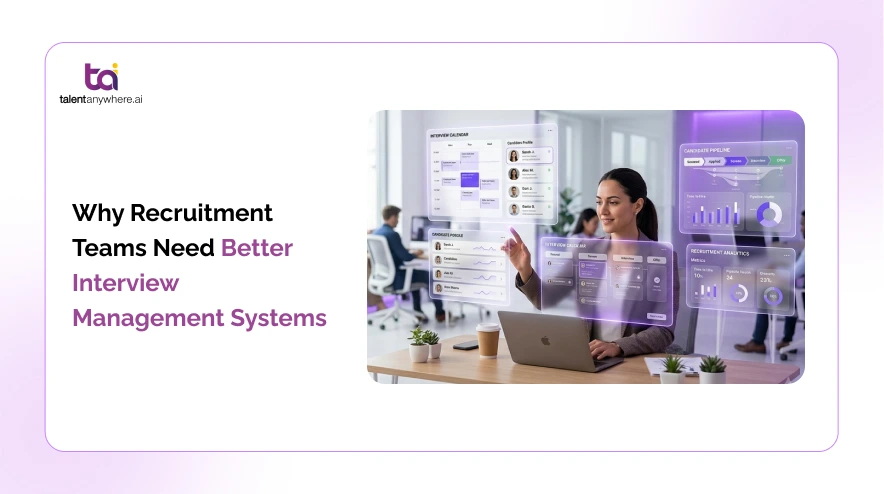
5. Centralised visibility for hiring teams
A single dashboard that shows interviewer assignments, feedback status, candidate pipeline stage, and communication history eliminates the siloed spreadsheets and fragmented email threads that characterise manual interview management. Hiring managers and HR leads operate from the same information, which means faster decisions and fewer coordination errors.
6. Scalability for high-volume and global hiring
Bulk scheduling, multi-timezone coordination, panel management across geographies, and compliance tracking are not problems that generic tools handle gracefully. For enterprises running Global Capability Centre (GCC) builds, mass hiring drives, or distributed hiring across APAC, the Middle East, or Europe, a purpose-built IMS is not a nice-to-have. It is a prerequisite for maintaining process quality at scale.
7. Data-driven hiring decisions
Reporting dashboards surface time-to-hire by role, candidate drop-off by stage, interviewer feedback SLA compliance, and panel performance over time. HR managers gain the evidence they need to identify bottlenecks, make a case for process changes, and report hiring performance to leadership with accuracy.
8. Better collaboration across hiring teams
When recruiters, hiring managers, and interviewers can rate, comment, and tag candidates within a shared platform in real time, hiring decisions move faster and with more confidence. Team-wide visibility avoids redundant debrief conversations and ensures that every voice in the panel has been heard before a decision is made.
9. Improved interviewer accountability
SLA tracking, automated feedback reminders, and certified interviewer panels hold interviewers accountable for completing their part of the process on time. This reduces no-shows, late feedback, and last-minute panel mismatches all of which introduce delay and create a poor experience for candidates.
10. Compliance and data security
Role-based access controls, encrypted candidate data, and workflows built to GDPR and CCPA standards protect sensitive information throughout the interview process. For enterprises managing cross-border hiring, this is not optional. A compliant interview management system ensures that candidate data is handled correctly, regardless of where the hiring activity takes place.
What a Good Interview Management System Should Do
If you are evaluating platforms, treat this as your baseline checklist. Any system worth deploying should cover the following:
Automated scheduling with candidate self-booking: Candidates should be able to select from available slots directly, without email back-and-forth. The system should handle calendar sync, availability detection, and confirmation automatically.
Structured interview kits with scoring rubrics: Interviewers should receive role-specific questions, evaluation criteria, and rating scales before the session begins. Assessments should be submitted within the platform.
Collaborative feedback collection before the debrief: Feedback should be captured independently from each interviewer and made visible to the hiring team only after submission, to prevent groupthink or anchoring.
Real-time pipeline visibility for all stakeholders: Every member of the hiring team should be able to see where each candidate stands, which rounds are pending, and what feedback has been submitted.
Candidate communication at every stage: Confirmations, reminders, status updates, and follow-up messages should be triggered automatically, so no candidate is left waiting without acknowledgement.
Integration with existing ATS or HRMS: An IMS should sit cleanly alongside your existing technology stack, not replace it. Two-way sync with your ATS ensures data consistency across the hiring pipeline.
Multi-timezone and global hiring support: Scheduling logic should account for interviewer and candidate time zones automatically. Panel coordination across geographies should require minimal manual intervention.
Compliance and data security: GDPR and CCPA compliance, role-based access, and audit trails should be standard, not enterprise add-ons.
How Poor Interview Management Hurts Your Employer Brand
The effects of a broken interview process extend beyond a single lost hire. Candidates talk. Reviews on employer reputation platforms are shaped significantly by the interview experience, and a negative account from one candidate can influence the decisions of many more.
For enterprises building GCCs (Global Capability Centres), scaling teams across new markets, or hiring at volume for technical roles, this matters at a business level. Offer acceptance rates decline when the interview process signals organisational dysfunction. Referral rates from existing employees fall when they feel uncomfortable putting their network through a slow or disorganised process. And recruiting costs rise when the funnel has to be continually rebuilt to compensate for drop-off at the interview stage.
The interview process is not just an operational function. It is a primary touchpoint in your employer brand, and it deserves the same level of design and investment as any other candidate-facing experience.
Interview Management for Global and Distributed Teams
Standard scheduling tools were not designed for hiring across multiple time zones, languages, or regulatory environments. When an interview panel spans Bengaluru, Dubai, and London, the operational complexity multiplies quickly. Slot availability becomes harder to calculate manually. Compliance requirements vary by geography. Communication expectations differ across candidate markets.
Enterprises running GCC (Global Capability Centre) builds or scaling distributed teams across APAC and the Middle East need interview management infrastructure that handles this complexity without relying on manual coordination. That means automated timezone detection, panel scheduling logic that respects availability across geographies, and compliance workflows that adjust to the regulatory context of each hiring location.
Generic tools break down at this scale. A purpose-built interview management system does not.
How talentanywhere.ai Streamlines the Interview Process
talentanywhere.ai is built for exactly the kind of hiring complexity described above. The platform’s Interview Lifecycle Management module brings structured assessment workflows, automated scheduling, and centralised feedback collection into a single environment designed for enterprise hiring teams.
Recruiters move candidates through interview stages without manual coordination overhead. Interviewers receive structured kits before every session. Feedback is collected, tracked, and surfaced to the right stakeholders at the right time. And hiring managers get the visibility they need to make faster, better-informed decisions.
For organisations managing high-volume hiring, distributed teams, or GCC builds, talentanywhere.ai removes the friction that causes great candidates to drop off and replaces it with a process that reflects well on your organisation at every touchpoint.
Conclusion
Hiring is not won or lost at sourcing. It is won or lost at the interview stage where process quality, speed, and candidate experience determine whether the best people stay in your pipeline or move on to a competitor.
A purpose-built interview management system is not an upgrade to your existing process. It is a replacement for the broken one. The right platform reduces time-to-hire, improves evaluation consistency, takes administrative burden off your team, and delivers a candidate experience that strengthens your employer brand.
If your interview process is still running on email and spreadsheets, the cost is already showing up in your hiring data.
Read summarized version with


talentanywhere.ai Blog
Explore insights on job readiness, global hiring trends, AI-powered recruitment, and career growth strategies. Our blog brings you practical tips, product highlights, expert advice, and success stories to--empowering job seekers, recruiters, and businesses to connect with the right talent, anywhere.
![How to Write Work Experience in Resume [With Examples & Tips]](https://talentanywhere.ai/wp-content/uploads/2026/06/Hero-How-to-Write-Work-Experience-in-Resume-1-300x168.webp)