



Table of Contents
 Set as a preferred Google source
You’re this close to finishing your resume. The experience section looks good. The skills are in. And then you hit the summary box at the top and your mind goes completely blank.
What do you even write there? How do you sum yourself up in four lines without sounding like a robot or a walking list of buzzwords?
You’re not alone. The resume summary trips up everyone from freshers applying for their first job to senior professionals with 15 years of experience. This post gives you ready-to-use resume summary examples for every career stage, a simple formula you can use to write your own in under five minutes, and the five mistakes that stop your resume from getting shortlisted before it reaches a human.
Whether you’re a fresher with no work experience, a mid-career professional looking to level up, a senior leader targeting your next big role, or someone switching careers entirely, there’s a section here for you.
What Is a Resume Summary (and Why It Matters More Than You Think)
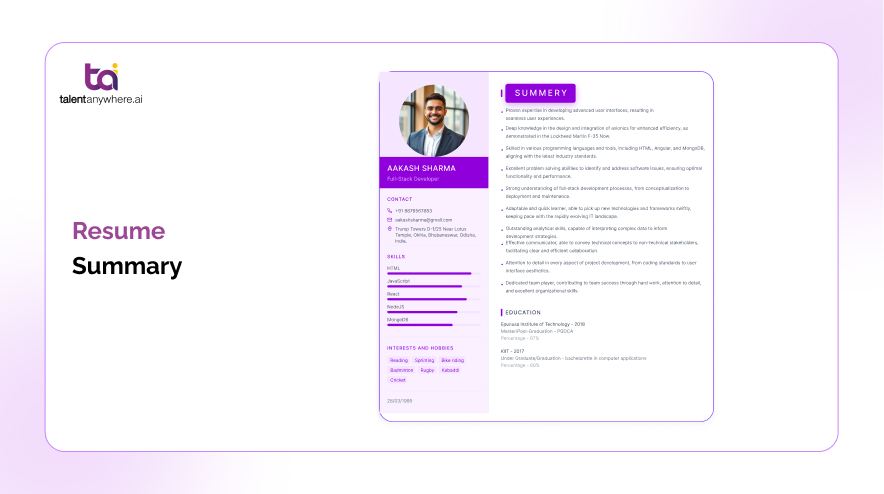
A resume summary is a short paragraph at the very top of your resume, typically two to four lines, that tells a recruiter who you are, what you do, and what you bring to the role. Think of it as your professional introduction before the interview.
Here is why it matters more than most candidates realise: it is the first thing a recruiter reads. Research consistently shows that recruiters spend an average of six to seven seconds scanning a resume before deciding whether to read further. If your summary does not hook their attention in those first seconds, the rest of your resume may never get the attention it deserves.
Resume Summary vs Resume Objective: Which Should You Use?
These two are often confused but they serve different purposes.
A resume summary is for candidates who have some experience to draw from, even if that experience is a college project, an internship, or part-time work. It leads with what you offer the employer.
A resume objective states what you hope to gain from the role. It is largely considered outdated, but remains acceptable for candidates applying for their very first job with zero professional experience.
Quick comparison:
Summary: “Marketing graduate with hands-on experience running social media campaigns for two student-led organisations, seeking to bring content strategy skills to a fast-growing brand.”
Objective: “Recent B.Com graduate seeking an entry-level finance role to develop professional skills in a structured environment.”
If you have any experience at all, even informal, go with the summary.
How Long Should a Resume Summary Be?
Direct answer: two to four sentences, between 40 and 80 words. No longer.
Here is a simple guide:
Under 25 words: Too vague to be useful. Recruiters get nothing to work with.
40 to 80 words: The sweet spot. Specific, readable, easy to scan.
Over 90 words: Gets skipped. A long summary signals poor communication, which is the opposite of what you want to demonstrate.
The Resume Summary Formula That Works at Any Career Stage
You do not need to write your summary from scratch. Every strong summary follows a three-part structure. Once you know the structure, writing your own takes less than five minutes.
Part 1: Who You Are (Your Professional Identity)
Your first line should state your role or professional identity clearly.
Fresher: Lead with your degree or field of study. Example: “Final-year Computer Science graduate from Delhi University…”
Experienced professional: Lead with your job title and years of experience. Example: “Digital marketing professional with six years of experience in B2B SaaS…”
Career changer: Lead with the role you are moving into, not the one you are leaving. Example: “Aspiring data analyst with a background in financial operations…”
This one line does more work than people realise. It orients the recruiter instantly.
Part 2: What You Bring (Your Top Two to Three Skills or Strengths)
The middle section highlights the two or three most relevant skills or strengths for the target role. The key here is matching the language in the job description.
If the JD says “stakeholder management” and you write “cross-functional communication,” ATS software may not connect the two. Lift the exact phrases from the job posting and work them naturally into your summary. This is one of the easiest ways to improve your ATS score without gaming the system.
Not sure which skills to lead with? Use the Skill Upgrade tool to see which skills appear most in the roles you’re targeting. And if you want a longer view, our guide to high-paying skills of the future is worth a read before you finalise what to include.
Part 3: What You Want to Do (Your Goal or Value to the Employer)
Your closing line should state the value you bring to the role. Frame it as something you do for the employer, not something you hope to get for yourself.
Wrong: “Looking for a challenging opportunity to grow my skills in a dynamic environment.”
Right: “Keen to apply content strategy and SEO expertise to help a growing brand build audience trust and organic reach.”
The difference is simple: one is about you, the other is about them.
Resume Summary Examples for Freshers and Recent Graduates
The blank summary feels impossible when you have no work experience. But here is the truth: you have more to work with than you think. Your degree, final-year project, internship, part-time job, society leadership, volunteering, even the skills you picked up organising a college event. All of it counts.
The examples below cover five different fresher situations. Each one is ready to adapt.
Fresher With No Work Experience (General)
| Fresher — No Work Experience |
| Recent B.A. English graduate from Shri Ram College of Commerce with strong research, writing, and communication skills developed through academic projects and editorial work for the college magazine. Comfortable working with tight deadlines and diverse teams. Eager to bring content creation and analytical thinking to an entry-level marketing or communications role. → Leads with education, backs up soft skills with brief evidence, closes with a clear direction. |
Fresher With an Internship or Part-Time Job
| Fresher — Internship |
| Digital marketing graduate with two internships in content and social media, including a three-month stint with a Bengaluru-based D2C brand where I helped grow Instagram engagement by 34%. Skilled in SEO writing, Meta Ads basics, and Google Analytics. Looking to bring this hands-on experience into a full-time content or growth marketing role. → Uses a quantified result, references real tools, positions toward the next role. |
Fresher Applying for a Technical Role (Engineering / IT / Data)
| Fresher — Technical Role |
| B.Tech Computer Science graduate (2025) with practical experience in Python, SQL, and machine learning through academic projects, including a final-year capstone that built a churn prediction model for a simulated e-commerce dataset. Comfortable with Jupyter Notebooks, Pandas, and Scikit-learn. Ready to contribute to a data or software engineering team from day one. → Names specific tools for ATS, references a real project, avoids generic skill dumps. |
Fresher Applying for a Non-Technical Role (Marketing / HR / Finance)
| Fresher — Non-Technical Role |
| B.Com graduate with a keen interest in human resources and organisational behaviour, backed by coursework in labour law and talent management. Led recruitment and onboarding for 40+ volunteers as head of the cultural society at Miranda House. Analytical, detail-oriented, and genuinely passionate about building workplaces where people do their best work. → Pairs soft skill claims with real evidence from student leadership. |
Fresher With a Gap Year or Non-Linear Path
| Fresher — Gap Year |
| Aspiring communications professional with a B.A. in Sociology and a year of self-directed learning in digital content, UX writing, and brand strategy through online courses and freelance projects. Developed a working understanding of SEO fundamentals and audience research during this period. Now ready to bring a curious, self-motivated approach to a content or brand team. → Acknowledges the gap without apologising, frames time positively, stays forward-looking. |
Ready to apply? Find roles matched to your profile.
Use talentanywhere.ai to search thousands of global opportunities by skill, role, and location.
Resume Summary Examples for Mid-Career Professionals (2 to 10 Years’ Experience)
Mid-career professionals face a different challenge. Their summaries are often either too modest (underselling real seniority) or too generic, reading like they could belong to anyone with a LinkedIn profile. A strong mid-career summary leads with your title and experience level, includes at least one measurable achievement, and makes clear the value you bring to the next role. If you’ve been promoted and need to reflect that on the rest of your CV, our guide on how to show a promotion on your resume covers exactly how to do it.
Mid-Career Example: Marketing or Content Professional
| Mid-Career — Marketing / Content |
| SEO and content strategist with six years of experience driving organic growth for B2B SaaS and e-commerce brands. Grew organic traffic by 210% over 18 months at a Series B startup through a combination of long-form content, technical SEO fixes, and strategic link building. Skilled at turning complex products into content that ranks and converts. Ready to bring this playbook to a data-driven marketing team. → Seniority clear from line one, time-bound metric, employer-focused close. |
Mid-Career Example: Software Engineer or Developer
| Mid-Career — Software Engineer |
| Full-stack developer with five years of experience building scalable web applications using React, Node.js, and PostgreSQL. Shipped a customer-facing portal used by over 80,000 users that reduced support ticket volume by 28%. Known for writing clean, maintainable code and taking ownership of features from spec to deployment. Looking to contribute to a product team that values both technical quality and user impact. → Names stack for ATS, connects technical output to business result, signals cultural fit. |
Mid-Career Example: Sales or Business Development
| Mid-Career — Sales / Business Development |
| B2B sales professional with seven years of experience in enterprise SaaS, consistently closing deals in the Rs. 20L to Rs. 2Cr range. Achieved 118% of annual quota for three consecutive years while managing a 40-account portfolio. Strongest at mid-funnel: qualifying opportunities, navigating stakeholder groups, and building the business case that gets contracts signed. Targeting a senior AE or business development manager role. → Deal size + quota = two numbers sales hiring managers look for first. Pattern not one-off. |
Mid-Career Example: HR or People Operations
| Mid-Career — HR / People Ops |
| HR generalist with eight years of experience supporting mid-size organisations across talent acquisition, onboarding, and employee relations. Reduced average time-to-hire from 42 days to 27 days by redesigning the screening process and introducing structured interviews. Comfortable as an HRBP for 150 to 300-person teams. Looking to step into a people operations lead role where I can own the full employee lifecycle. → Before-and-after metric, process ownership not just execution, specific scale fit. |
Resume Summary Examples for Senior and Leadership Roles
At the senior level, the most common summary mistake is writing about what you have done rather than what you lead. Recruiters hiring at director, VP, or C-suite level want to understand your scope, your business impact, and the kind of organisation you add the most value to. Keep it strategic.
Senior Example: Team Lead or Engineering Manager
| Senior — Engineering Manager |
| Engineering manager with 11 years in software development and three years leading high-performing backend teams. Currently managing a team of 12 engineers building core infrastructure for a fintech platform processing 2M+ daily transactions. Under my leadership, the team reduced P1 incident frequency by 60% and shipped three major platform upgrades on schedule. Looking for a director-level role at a scaling product organisation. → Separates IC depth from leadership tenure, reliability metric + scale convey real weight. |
Senior Example: Marketing or Growth Leader
| Senior — Marketing / Growth Leader |
| Growth marketing leader with 14 years of experience owning demand generation and brand strategy for B2C and B2B SaaS businesses. Led a 22-person marketing team to deliver a 3.4x increase in qualified pipeline over two years, supporting a Series C fundraise and expansion into three new markets. Hands-on with both strategy and execution. Ready to take on a CMO or VP Marketing role at an ambitious growth-stage company. → Commercially grounded metric, real business context, addresses the ‘lost touch with execution’ concern. |
Senior Example: Operations or General Management
| Senior — Operations / GM |
| Operations and general management leader with 16 years of experience scaling organisations from 50 to 500+ people across India and Southeast Asia. Built the end-to-end supply chain for a consumer brand from scratch, reducing fulfilment costs by 32% while improving on-time delivery to 97%. Strong track record in turnaround and scaling contexts. Seeking a COO or VP Operations role where operational rigour and commercial thinking need to work in tandem. → Headcount range signals scale comfort, two metrics show efficiency without quality loss. |
Resume Summary Examples for Career Changers
A career change summary works best when it focuses on what transfers, not what does not. The biggest mistake career changers make is writing a summary that belongs to their old career. Lead with the destination, bridge your transferable skills, and show the recruiter you understand the new field.
Career Change Example: Moving Into Tech or Data Roles
| Career Change — Into Tech / Data |
| Aspiring data analyst with eight years of experience in financial operations, where I built reporting frameworks, managed large datasets in Excel and SQL, and produced commercial forecasts used by senior leadership. Completed the Google Data Analytics Certificate (2025) and a Python for Data Science bootcamp. Making a deliberate move into analytics to apply my financial domain knowledge in a data-first environment. → Opens with destination role, bridges existing analytical work, certifications framed as preparation. |
Career Change Example: Moving Into People-Facing or Coaching Roles
| Career Change — Into People / Coaching |
| HR and learning development professional (in transition) with 10 years in operations management, where I led onboarding for teams of up to 80 people, designed process training programmes, and informally mentored seven team members into leadership positions. Deeply interested in structured people development and currently completing a SHRM-CP certification. Ready to bring a practical, operations-informed perspective to an L&D or HR business partner role. → Evidence of people work already done, specific mentoring outcome, differentiator not generic aspiration. |
Career Change Example: Moving Into a Leadership or Management Role
| Career Change — Into Management |
| Senior software engineer with nine years of individual contribution, now stepping into engineering management. Have led cross-functional delivery of two major product launches as informal tech lead, managed relationships with product and design stakeholders, and mentored four junior engineers who have since moved into mid-level roles. Completed a structured management training programme through my current employer. Ready to take formal ownership of a team and its growth. → Frames shift as natural progression, informal leadership as concrete evidence, promotions speak for readiness. |
5 Resume Summary Mistakes That Get You Rejected Before the Interview
Here are the 5 resume summary mistakes that gets your resume rejected instantly:
Mistake 1: Writing a Vague Opening Line
“Hardworking and motivated professional with a passion for excellence.” This tells a recruiter nothing. The first sentence must state your professional identity clearly. If a stranger could not identify your field from your opening line alone, rewrite it from scratch.
Mistake 2: Copying a Generic Template Without Tailoring
A summary that could belong to 10,000 other candidates will be treated like one. Every summary should contain at least one specific detail (a result, a skill, a sector, a tool) that connects it directly to the role you are applying for. Recruiters can spot a pasted template in under three seconds approximately.
Mistake 3: Focusing on What You Want Instead of What You Offer
“Seeking a challenging role where I can develop my skills and grow professionally.” That is a wish list, not a value proposition. Recruiters are scanning for what you bring to the team, not what you hope to take away. Flip every sentence from self-focus to employer-focus before you submit.
Mistake 4: Making It Too Long
Anything beyond four sentences risks being skimmed or skipped entirely. Recruiters are looking at hundreds of CVs. A bloated summary signals weak communication skills, which is the opposite of what you want to demonstrate at the very top of your resume.
Mistake 5: Not Including Keywords From the Job Description
88% of employers admit their ATS screens out qualified candidates simply because their resume does not exactly match the language in the job description. ATS software scans the summary for keywords from the job posting before a human ever reads it. If the language does not match, your application scores lower automatically. Mirror the exact phrasing from the JD, not your paraphrased version. “Stakeholder management” and “cross-functional communication” are not the same thing in an ATS.
Conclusion
Your resume summary is not decoration at the top of a document. It is a recruiter’s first impression of you in writing. Get it right and they read everything else with interest. Get it wrong and the rest of your resume may not get the attention it deserves.
The good news: a well-crafted summary that speaks directly to the role you want takes less than five minutes when you use the three-part formula above. Identify who you are, what you bring, and the value you offer, then shape it into 40 to 80 words that sound like a real person wrote them. Find roles matched to your skills on talentanywhere.ai and apply with a resume that stands out from the very first line.
Read summarized version with


talentanywhere.ai Blog
Explore insights on job readiness, global hiring trends, AI-powered recruitment, and career growth strategies. Our blog brings you practical tips, product highlights, expert advice, and success stories to--empowering job seekers, recruiters, and businesses to connect with the right talent, anywhere.
![How to Write Work Experience in Resume [With Examples & Tips]](https://talentanywhere.ai/wp-content/uploads/2026/06/Hero-How-to-Write-Work-Experience-in-Resume-1-300x168.webp)