

Table of Contents
 Set as a preferred Google source
Every talent acquisition team knows the volume problem. A single mid market job posting can pull in several hundred applications within days, and most of them do not belong anywhere near the role. Recruiters end up spending the bulk of their week opening resumes that were never a fit, while the handful of genuinely strong candidates sit buried somewhere on page four of the applicant list. By the time a recruiter reaches them, fatigue has already set in, and the review that candidate gets is rushed, distracted, or inconsistent with the review given to applicant number twelve.
This is the real cost of high volume hiring. It is not just slower time to fill. It is a quality problem, because the people making shortlist decisions are stretched too thin to make them well. Resume screening was supposed to be the filter that protects quality. In practice, when it is done manually at scale, it often does the opposite.
AI resume screening exists to fix exactly this failure point. Done well, it does not just move faster than a human reviewer, it applies a more consistent, more complete standard to every single application, which is what actually determines whether the people who reach an interview are the right people. This piece looks at how that works, why manual shortlisting struggles to keep pace, and what a talent team should look for before trusting an AI tool with something as important as its shortlist.
Drowning in applications?
Let talentanywhere.ai surface your strongest candidates first
What AI Resume Shortlisting Actually Does
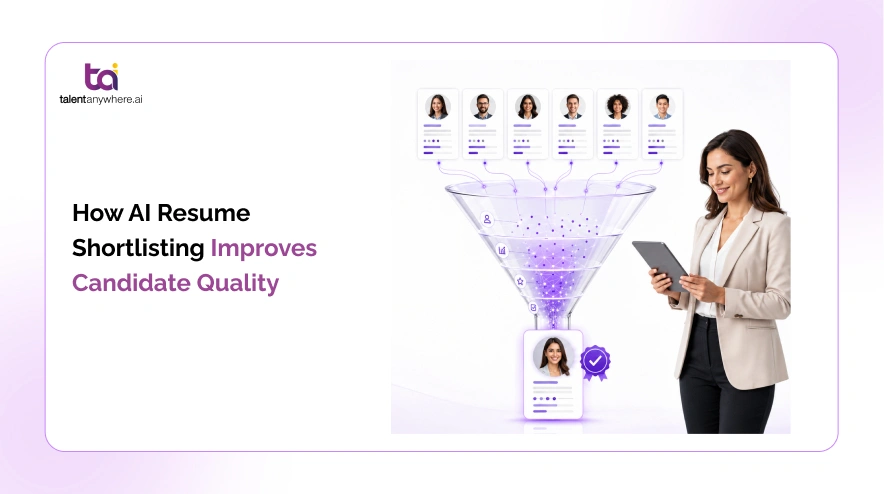
At its core, AI resume screening runs on three connected steps: parsing, matching, and ranking.
Parsing is the extraction layer. Resume parsing software reads an unstructured document, whether it is a PDF, a Word file, or a LinkedIn export, and converts it into structured data such as job titles, employers, dates, skills, certifications, and education. This is the same task a recruiter does manually when scanning a resume, except the software does it in a fraction of a second and does not skip a section because it is tired or in a hurry.
Matching is where the parsed data gets compared against the requirements of the open role. A strong system does this on substance, not just vocabulary. Instead of asking whether the word project management appears somewhere on the page, it looks at demonstrated experience, such as years in a comparable role, tools actually used, and outcomes described, and weighs that against what the job genuinely requires.
Ranking is the output. Every candidate who applies gets scored against the same criteria and surfaced in order, so the recruiter’s attention goes to the applicants most likely to be a fit first, rather than whoever happened to apply earliest or format their resume most attractively.
None of this replaces recruiter judgment. It replaces the part of the process where judgment cannot realistically be applied at volume, which is the first pass through hundreds of resumes that mostly do not belong in the pipeline.
Also Read More : AI Recruitment Tools Every Hiring Team Should Know
Why Manual Shortlisting Lets Quality Slip
Manual screening is not a quality problem because recruiters lack skill. It is a quality problem because of the conditions manual screening is done under.
Reviewer fatigue is the first factor. Attention and judgment are not constant across a stack of two hundred resumes. The candidate reviewed at 9 a.m. gets a different level of scrutiny than the candidate reviewed at 4 p.m. after six back to back interviews, and that difference has nothing to do with who is actually more qualified.
Inconsistency between recruiters compounds the problem. Two recruiters on the same team, screening for the same role, will draw the line in slightly different places, because good enough is a judgment call and judgment calls vary between people. In a high volume hiring organization with multiple recruiters working the same requisition pool, that variance means candidate quality on the shortlist depends partly on which recruiter happened to open a given resume.
Keyword stuffed resumes make it worse. Candidates and resume writers have learned that human reviewers scan quickly and respond to surface signals such as bolded skills sections and job titles that echo the posting. A resume can look like a strong match at a glance without the underlying experience to back it up, and a rushed reviewer is exactly the audience that surface formatting is designed to fool.
The result is a shortlist shaped as much by reviewer fatigue, individual judgment differences, and resume formatting as by actual candidate fit. Fixing that is a structural problem, not a training problem, which is why software built for consistency addresses it more directly than asking recruiters to simply be more careful.
Also Read More : Why Recruitment Teams Need an Interview Management System
Five Ways AI Screening Raises Candidate Quality
AI screening raises candidate quality in five main ways.
Consistent scoring across every applicant
Automated resume screening applies the same criteria to candidate one and candidate three hundred, in the same order, with the same weighting. There is no late afternoon drop off in attention and no drift in standards between recruiters. Every applicant is measured against the role, not against whoever the reviewer compared them to five minutes earlier.
Skills based matching instead of surface keyword matching
Rather than checking for the presence of a phrase, ai candidate screening tools built for quality evaluate the substance behind a claim, such as how long a candidate actually worked with a tool, what they built or delivered with it, and whether their trajectory matches the seniority the role requires. This is what separates screening that improves quality from screening that just filters faster.
Bias reduction through structured criteria
When every candidate is evaluated against the same defined rubric, the room for unconscious bias to influence which resume gets a second look narrows considerably. This does not eliminate the need for oversight, but structured, criteria based evaluation is measurably harder to skew than a fast, informal human read.
Surfacing strong candidates who would otherwise be overlooked
Career changers, candidates with nontraditional paths, and people whose resumes are not optimized for a six second scan often have exactly the experience a role needs, described in a way a rushed reviewer would miss. Structured matching evaluates the substance of their background rather than how well it was packaged, which is often where the strongest hires are hiding.
Freeing recruiter time for deeper evaluation of the shortlist
Every hour a recruiter does not spend triaging unqualified applications is an hour available for the part of the job that actually determines quality of hire, which is a real conversation, a thoughtful interview, and a considered decision about the finalists. AI screening does not remove the recruiter from the process. It moves their time to the part of the process where human judgment adds the most value.
SHRM’s 2025 recruiting benchmarking research found that only 20 percent of organizations currently track quality of hire, even though it is the metric that matters most. Screening built for consistency rather than speed alone gives talent teams a real shot at improving that number, because it changes what happens before a hire is ever tracked.
Shortlist on fit, not formatting
Structured, skills based scoring for every application you receive
What to Look For in an AI Screening Tool
Not every resume screening software product on the market is built with quality in mind. Some are optimized purely to cut volume, which can quietly filter out strong candidates along with the weak ones. A few things separate tools that genuinely raise candidate quality from ones that just move faster.
Explainability
A recruiter should be able to see why a candidate scored the way they did, not just the final number. If a tool cannot show its reasoning, it cannot be trusted to make decisions that affect real people’s careers, and it cannot be defended if a hiring decision is ever questioned.
Bias controls
Look for tools that let you configure and audit the criteria being used, rather than a black box scoring model. Structured, visible criteria are what make bias reduction possible in the first place.
ATS fit
AI resume screening tools need to work inside the systems a talent team already runs on, not alongside them as a separate step that creates more manual work rather than less.
Configurable scoring
Every role weighs experience, skills, and education differently. A senior engineering hire and an entry level operations hire should not run through an identical rubric. The best resume screening software lets talent teams adjust what matters most for each requisition, rather than forcing every role through the same template.
Talent teams evaluating vendors should treat these four criteria as a baseline, not a wishlist. A tool that cannot explain a score, cannot be audited for bias, does not fit the existing ATS, or cannot be configured per role is not built for quality, whatever its marketing promises.
Also Read More : How AI Enhanced Resumes Are Getting 3x More Callbacks
How talentanywhere.ai Approaches Quality Shortlisting
talentanywhere.ai was built around a simple premise: speed only matters if it protects, rather than compromises, candidate quality. The resume shortlister applies structured, skills based matching to every application, so recruiters are working from a shortlist that reflects genuine fit rather than resume formatting or keyword density. Scoring is transparent, criteria are configurable per role, and the system is built to integrate into the workflows high volume talent teams already run, rather than adding a new one on top.
The goal is not to hand recruiters a shorter list. It is to hand them a better one, so the time they spend on final review goes toward candidates who were evaluated consistently and fairly from the very first pass.
Quality and Speed Are Not a Tradeoff
The assumption that AI screening trades candidate quality for speed gets the relationship backwards. Manual screening at high volume is where quality actually breaks down, through fatigue, inconsistency, and resumes engineered to beat a quick scan. Structured, explainable AI screening is what restores consistency to that first pass, and it is what gives recruiters the time back to do the part of their job that genuinely requires human judgment.
The organizations getting this right are not choosing between fast and good. They are using AI resume screening to make sure the candidates who reach a human are the ones actually worth that person’s time. If your team is still deciding what quality first screening should look like, talentanywhere.ai’s enterprise resume shortlister is worth a look.


talentanywhere.ai
Build professional resumes with AI, improve your ATS score, and apply with confidence. talentanywhere.ai empowers job seekers with smarter resume creation and career tools for every stage.