

Table of Contents
 Set as a preferred Google source
An applicant tracking system, or ATS, is software that helps recruiters and hiring teams post jobs, collect and organize resumes, and move candidates through each stage of the hiring process from one dashboard. For any company fielding more than a handful of applications per opening, a spreadsheet and a shared inbox stop working fast. Resumes pile up in different formats, feedback gets lost in email threads, and good candidates slip through simply because nobody was tracking where they stood. This guide walks through what an ATS actually is, how it works behind the scenes, the features that matter, and what to look for if your team is evaluating one for the first time.
What is an applicant tracking system (ATS)
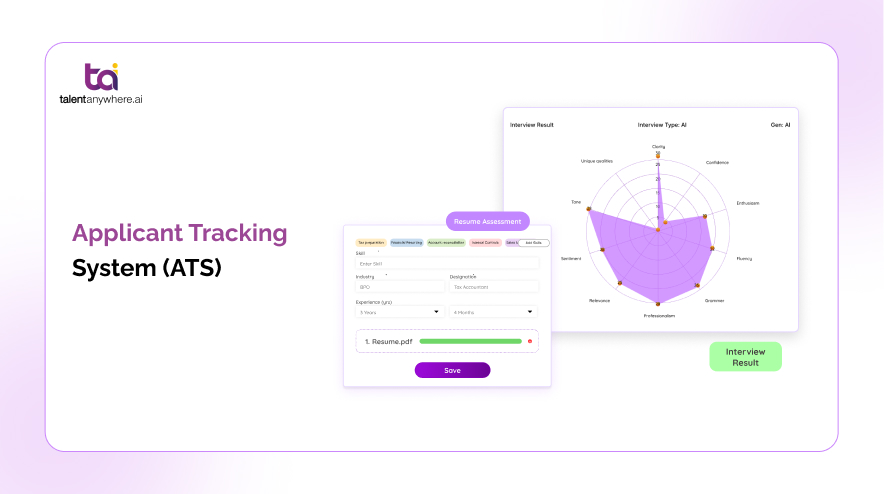
An applicant tracking system is a piece of recruiting software that manages the entire hiring workflow in one place. It collects job applications, extracts and organizes resume data, screens and ranks candidates against a role’s requirements, and gives recruiters and hiring managers a shared view of every candidate’s status from application to offer.
ATS meaning in simple terms
Think of an ATS as the digital filing cabinet and workflow engine for hiring. Before this kind of software existed, recruiters relied on paper resumes, folders, and spreadsheets to keep track of who applied for what. An ATS replaces all of that with a searchable database. Every application that comes in through a careers page, job board, or referral link lands in the same system, tagged to the right job requisition, so nothing gets lost and nobody has to dig through an inbox to find a candidate’s resume.
Why companies use an applicant tracking system
Once a company grows past a small team doing occasional hiring, manual tracking becomes a liability rather than a habit. Recruiters need to compare candidates fairly, hiring managers need visibility into where a role stands, and compliance teams need a clean audit trail of how decisions were made. According to Harvard Business School and Accenture’s Hidden Workers research, more than 90 percent of employers now use a recruiting system to make an initial cut or rank applicants for open roles, rising to 94 percent for middle skills positions. That level of adoption reflects a simple reality: once application volume passes a certain point, a system built for search, comparison, and collaboration is no longer optional.
Hiring should not feel like guesswork
See how talentanywhere.ai screens candidates in, not out.
How does an applicant tracking system work
An ATS works by moving a candidate through a defined pipeline, starting the moment a job is posted and ending when an offer is signed. Each stage below represents a step most systems handle automatically or semi automatically, though the exact sequence varies by vendor and by how a company configures its workflow.
Job requisition and posting
The process starts when a hiring manager opens a requisition inside the ATS, describing the role, the required qualifications, and the approval chain. Once approved, the system distributes that posting to the company’s careers page and, often through built in integrations, to external job boards and social channels at the same time. This step alone removes a huge amount of manual copy and paste work, since the same job description does not need to be reformatted and republished on five different sites by hand.
Resume parsing and data extraction
When a candidate applies, the ATS parses their resume, pulling out structured information such as work history, education, skills, certifications, and contact details, and storing it in searchable fields rather than as a static document. This is the step that turns an unstructured PDF or Word file into data the system can actually search and sort. Parsing accuracy varies depending on resume formatting, which is why plain, well organized resumes tend to move through these systems more cleanly than heavily designed ones with columns, graphics, or text boxes.
Screening, keyword matching, and candidate ranking
Once a resume is parsed, the ATS compares it against the criteria a recruiter has set for the role, things like required skills, years of experience, certifications, or education level, and produces a ranked or filtered list. This is also where hiring teams need to be deliberate. The same Harvard Business School and Accenture research found that 88 percent of employers agreed that qualified, higher skilled candidates get filtered out of consideration simply because their resumes do not match the exact language used in the job description, not because they lack the underlying skill. The researchers pointed to overly rigid filters, such as automatic exclusion for employment gaps or narrow keyword requirements, as the real source of the problem rather than the technology itself. That is a strong argument for configuring screening criteria around a handful of true minimum requirements rather than an exhaustive wish list. Tools like AI powered resume shortlisting can help surface strong candidates without relying on rigid keyword rules alone.
88 percent of employers say good candidates get filtered out
talentanywhere.ai’s AI screening is built to fix that.
Also Read 5 Top Free Resume Builder Websites To Secure Your Dream Job
Candidate database and pipeline stages
Every candidate who applies is stored in a searchable database and assigned a stage, such as new, screening, interview, offer, or hired, so recruiters and hiring managers can see exactly where each person stands without asking around. This pipeline view is often the single most valuable part of an ATS for a growing team, because it turns hiring from a set of scattered conversations into one shared source of truth. Recruiters can also search the existing database for past applicants who might fit a new opening, instead of starting every search from zero.
Interviews, collaboration, and the hiring decision
As candidates move into later stages, the ATS typically handles interview scheduling, centralizes interviewer feedback and scorecards, and gives everyone involved in the decision a single place to compare notes before an offer goes out. This collaborative layer reduces the back and forth of separate email threads and calendar invites, and it creates a documented record of why a candidate was or was not moved forward, which matters for both hiring quality and compliance.
Key features of an applicant tracking system
Most applicant tracking systems share a common core of features, even though the depth and polish of each varies by product. Understanding these building blocks makes it easier to compare systems on substance rather than marketing.
- Job posting distribution to a careers page and external job boards from a single input
- Resume parsing that converts unstructured resumes into structured, searchable candidate profiles
- Pipeline management with customizable stages so every open role has a clear status
- Collaboration tools such as shared scorecards, interview feedback, and internal notes
- Reporting and analytics on metrics like time to fill, source of hire, and pipeline conversion
- Integrations with job boards, background check providers, calendars, and HR systems
Benefits of using an ATS for recruiters and HR teams
The case for adopting an ATS usually comes down to time, organization, and decision quality rather than any single feature. Teams that make the switch from spreadsheets and shared inboxes tend to see the same set of improvements regardless of industry.
A faster, more organized pipeline means recruiters spend less time hunting for information and more time actually talking to candidates. SHRM’s 2026 benchmarking research found that the median time to fill nonexecutive positions dropped to 39 calendar days, an improvement attributed in part to organizations refining their hiring processes and technology. A structured pipeline also tends to produce a better candidate experience, since applicants are less likely to be forgotten mid process when their status is tracked automatically rather than remembered by one person. On the employer side, reporting features give leadership real visibility into where hiring is slow, which sources produce the best candidates, and where the pipeline is losing people, turning hiring into something that can be measured and improved rather than a black box. Finally, a documented, consistent process supports compliance, since every screening decision and candidate interaction is logged in one auditable system rather than scattered across inboxes and sticky notes.
Also Read The Right Way to Present Skill Levels on Your Resume
Applicant tracking system vs recruitment CRM
It helps to be clear about what an ATS is not. An applicant tracking system and a recruitment CRM solve related but different problems, and confusing the two leads to buying the wrong tool. An ATS is built to manage active applicants moving through an open requisition, from application to offer. A recruitment CRM, by contrast, is built to nurture passive talent, people who are not currently applying anywhere but who a company wants to stay in touch with for future roles. Many modern hiring platforms blend both functions, but the underlying purpose is different: an ATS manages a pipeline that has a start and an end, while a CRM manages an ongoing relationship that may never convert into an application at all.
Types of applicant tracking systems
Not every ATS is built for the same buyer, and choosing the right category matters as much as choosing the right vendor. Systems generally differ along three lines: how they are deployed, who they are sized for, and who uses them.
By deployment, most modern systems are cloud based, meaning they are accessed through a browser and updated automatically, while a shrinking number of older, on premise systems still require local servers and manual updates. By size, small business focused systems tend to prioritize simplicity and quick setup, while enterprise systems are built to handle complex approval chains, multiple business units, and global compliance requirements. By focus, in house systems are designed for a single company’s internal recruiting team, while agency focused systems are built for staffing and recruitment firms that manage candidates across many different clients at once. Knowing which of these categories a company falls into narrows the field considerably before any specific product comparison even begins.
What to look for when choosing an ATS
Choosing an ATS is less about finding the system with the longest feature list and more about finding the one that fits how a specific team actually works. A few criteria consistently separate a good fit from a frustrating one.
Ease of use matters more than most buyers expect going in, since a system that recruiters and hiring managers find clunky simply will not get used consistently, no matter how powerful its backend is. AI powered screening and ranking capabilities are increasingly a baseline expectation rather than a premium add on, particularly for teams dealing with high application volume. Integrations with existing job boards, background check providers, calendar tools, and broader HR systems determine whether the ATS becomes a true hub or just one more disconnected tool. Scalability is worth checking even for a small team, since switching systems later, after years of candidate data has accumulated, is far more disruptive than choosing carefully the first time. Pricing structure, whether it is billed per seat, per requisition, or as a flat platform fee, should be evaluated against how the team actually hires, not just against the sticker price.
How AI is changing applicant tracking systems
Artificial intelligence has moved from a marketing checkbox to a core part of how modern applicant tracking systems function, and that shift is changing what recruiters expect from these tools. AI powered screening can now evaluate a candidate’s actual skills and experience against a role’s requirements with more nuance than a simple keyword match, which directly addresses the over filtering problem the Harvard Business School and Accenture research identified. Automated ranking helps recruiters prioritize the strongest applicants in a large pool without manually reading every resume, cutting hours out of the earliest, most repetitive stage of hiring.
AI is also being used to reduce certain forms of bias by standardizing how candidates are evaluated against defined criteria rather than leaving early screening entirely to individual judgment, though the quality of that outcome still depends heavily on how the underlying criteria are set. Automation extends beyond screening too, into scheduling, candidate assessment, and reporting, freeing recruiters to spend more of their time on the parts of hiring that genuinely require human judgment, like interviewing and closing candidates. Platforms like talentanywhere.ai are built around this shift, pairing AI powered candidate matching with tools recruiters and job seekers can both use, since the best outcomes happen when technology filters candidates in rather than filtering them out.
Fill roles faster with a smarter ATS
Post, screen, and manage candidates in one place with talentanywhere.ai.
FAQs
What does ATS stand for?
Does my company need an applicant tracking system?
How much does an ATS cost?
Is an ATS worth it for a small business?
What is an example of an applicant tracking system?
talentanywhere.ai Blog
Build professional resumes with AI, improve your ATS score, and apply with confidence. talentanywhere.ai empowers job seekers with smarter resume creation and career tools for every stage.