



Table of Contents
 Set as a preferred Google source
Your work experience is ready. What you don’t know is how to write it in a way that clears ATS filters and lands in front of a recruiter. Most resumes fail at this step. Not because the candidate lacks experience, but because the experience section is formatted incorrectly, written vaguely, or missing the keywords a recruiter’s system is scanning for.
This guide gives you the correct format to follow, real examples for five career profiles, and practical tips that work for any job, in any country. Whether you’re writing your first resume or updating one after years in the workforce, the work experience section is where your application wins or loses.
What Is the Work Experience Section in a Resume
The work experience section is the core of any resume. It is the section recruiters spend the most time reading and the one ATS (Applicant Tracking Systems) weight most heavily when scoring your application. A well-structured experience section tells a recruiter exactly what you’ve done, where you did it, and what you delivered.
Every entry must contain: your job title, the company name, your dates of employment, and 3-5 bullet points that lead with achievements, not generic duties.
Work Experience vs Professional Experience: Is There a Difference
In practice, no. “Work experience” and “professional experience” refer to the same section on a resume. “Professional experience” is more commonly seen at senior or corporate level; “work experience” is standard for all other candidates. The practical rule: mirror the exact phrasing used in the job description you are applying to. ATS systems match your resume language against the job description text, so using the same terminology directly affects your match score.
Where Does the Work Experience Section Go on a Resume
For anyone with one or more years of experience, the experience section belongs after your professional summary and before education and skills. For freshers with only internships, it still belongs near the top of the page. Never bury relevant experience below an education section.
Recommended order for experienced candidates:
Professional Summary → Work Experience → Skills → Education → Certifications
Recommended order for freshers
Professional Summary → Work Experience (internships) → Education → Skills → Projects
The Correct Format for Work Experience in a Resume
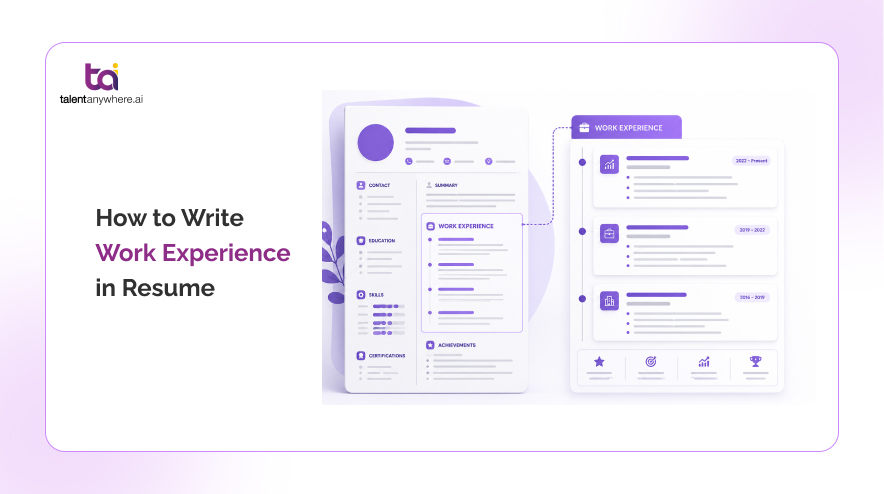
Getting the format right is the foundation. Copy the structure below directly rather than improvising. Knowing how to write work experience in a resume starts here: with a clean, ATS-compatible entry that every recruiter can scan in seconds.
The Standard Work Experience Entry: Exact Format to Copy
Job Title (bold) | Company Name | City, Country | Month Year – Month Year
- Action verb + task + result
- Action verb + task + result
- Action verb + task + result
- Action verb + task + result
Job Title (bold) | Company Name | City, Country | Month Year – Month Year
- Action verb + task + result
- Action verb + task + result
- Action verb + task + result
- Action verb + task + result
Full example:
Digital Marketing Manager | Apex Media Group | Singapore | Mar 2022 – Present
- Grew organic search traffic by 63% in 12 months through a targeted content and on-page SEO strategy
- Managed a monthly paid media budget of $18,000 across Google and Meta, achieving a 4.2x ROAS
- Led a team of three content specialists, delivering 20 campaign assets per quarter on schedule
- Introduced a reporting dashboard that reduced weekly reporting time by 4 hours
The pipe separator (|) is the ATS-compatible convention for separating header elements. Avoid slashes, hyphens between words, or custom symbols, as these can break ATS parsing.
Always List Most Recent Job First
Reverse chronological order is the global standard for how to list work experience on a resume. Recruiters scan top-to-bottom; they want to see your most current role immediately, not work backwards from where you started. ATS systems also default to parsing entries in reverse chronological order.
The most common mistake here: listing oldest experience first out of habit, or grouping roles by type rather than by date. Both approaches confuse ATS parsing and slow down a recruiter’s scan.
How to Write Employment Dates Correctly
Use this format: Month Year – Month Year. For a current role: Month Year – Present.
Acceptable:
- Jan 2022 – Mar 2024
- January 2022 – March 2024
Not acceptable:
- 2022-2024 alone: too vague for ATS date parsing
- “To date” or “Till date”: not standard in international resume formats
Always write “Present” for a current role. Regional conventions such as “To date” or “Till date” may not parse correctly across international ATS systems.
How Many Bullet Points Per Job
| Role Type | Recommended Bullets |
|---|---|
| Most recent / most relevant role | 4-6 |
| Older roles | 2-3 |
| Internships | 2-3 |
| Short or unrelated roles | 1 line acceptable |
Do not pad older roles with extra bullets to fill space. Two strong, quantified bullets on an older role are more effective than five vague ones.
How to Write Work Experience Bullet Points That Get Noticed
Bullet point quality determines shortlisting more than any other factor on your resume. This section covers action verbs, the achievement formula, quantification, and ATS keyword matching. These are the four elements that separate a resume that gets read from one that gets filtered out.
Start Every Bullet With a Strong Action Verb
Action verbs signal ownership and initiative. “Responsible for managing the team” is passive and weak. “Managed a cross-functional team of eight” is direct and ATS-friendly.
Use past tense for previous roles and present tense for your current role.
| Category | Action Verbs |
|---|---|
| Leadership | Led, Managed, Oversaw, Directed, Spearheaded |
| Achievement | Delivered, Grew, Reduced, Exceeded, Secured |
| Operational | Built, Implemented, Launched, Streamlined, Coordinated |
| Analytical | Analysed, Identified, Evaluated, Reported, Optimised |
The Formula: Action Verb + Task + Result
| Weak | Strong |
|---|---|
| Responsible for social media | Grew Instagram following by 45% in 6 months by implementing a data-led content calendar |
| Helped with data entry | Processed 500+ daily transactions with 99.8% accuracy, reducing reconciliation time by 2 hours per week |
| Worked on customer onboarding | Redesigned the onboarding flow for 200+ monthly sign-ups, cutting time-to-activation from 5 days to 2 |
The result does not always have to be a percentage. Time saved, volume handled, and scale reached are all valid metrics.
How to Quantify Achievements When You Think You Have No Numbers
Most candidates believe they have no metrics. In practice, there are almost always numbers; you just need to find them. Four methods:
- Time saved: “Reduced X process from Y hours to Z hours per week”
- Volume: “Managed a pipeline of 40 active clients” or “Processed 300+ orders daily”
- Percentage change: “Improved customer satisfaction score from 3.8 to 4.5 out of 5”
- Scale: “Supported a team of 12 across 3 departments”
For roles where a specific metric genuinely isn’t available, phrases such as “consistently” and “across multiple projects” add implied scale without fabricating data.
Match Your Language to the Job Description for ATS
ATS systems compare your resume text directly against the job description. “Stakeholder management” in the JD and “managing stakeholders” on your resume do not score identically. The closer the match, the higher your keyword score.
How to apply this:
- JD phrase: “experience with Agile project management”
- Your bullet: “Delivered 4 product releases per quarter using Agile sprint cycles across a team of 6 engineers”
Lift the exact phrase from the JD and work it naturally into a bullet, but only where it honestly reflects your experience. This step is completely absent from most resume guides, yet it is the one that most directly affects whether your application clears the ATS filter.
Work Experience Examples for Every Career Profile
This is the practical reference section. Five fully formatted resume work experience examples for the most common candidate situations, each globally applicable.
Example 1: Fresher With an Internship
Marketing Intern | A digital marketing agency | Remote | Jun 2024 – Aug 2024
- Assisted in managing 3 active social media accounts, contributing to a 22% increase in combined engagement over 8 weeks
- Researched and compiled weekly competitor analysis reports used directly by the senior strategy team
- Drafted 12 content briefs for blog posts; 8 were approved and published without major revision
What makes this effective: The candidate does not overclaim. Each bullet reflects intern-level scope while showing output volume, team contribution, and a measurable result. The most common mistake, writing either “did data entry” or “managed operations”, is avoided entirely.
Example 2: Software Engineer or IT Professional (2-5 Years)
Software Engineer | A B2B SaaS product company | Bengaluru, India | Jul 2021 – Present
- Developed and maintained RESTful APIs in Python (Django), supporting 50,000+ active daily users across 3 product modules
- Reduced average API response time by 35% through query optimisation and caching improvements
- Participated in bi-weekly Agile sprint reviews, contributing to 4 production releases per quarter
- Conducted peer code reviews for a team of 5 engineers, reducing post-deployment bugs by 18%
What makes this effective: Tech stack, delivery metric, team context, and a measurable quality improvement are all present. The entry reads like a delivery record, not a skills list.
Example 3: Marketing or Digital Marketing Professional
Digital Marketing Executive | A global e-commerce brand | Dubai, UAE | Feb 2022 – Dec 2024
- Managed SEO strategy for a product catalogue of 1,200+ SKUs, growing organic traffic by 58% year-on-year
- Ran Google Ads and Meta campaigns with a combined monthly budget of $12,000, maintaining an average ROAS of 3.8x
- Built and maintained reporting dashboards in Google Analytics and Looker Studio, reducing weekly reporting time by 3 hours
- Collaborated with the content team to produce 4 long-form articles per month; 70% ranked on page 1 within 90 days
What makes this effective: Every bullet names a channel, a tool, or a metric. Specific enough to be credible, broad enough to be globally recognizable.
Example 4: Career Gap or Freelance Period
A large proportion of global candidates have periods of freelancing, contracting, or career breaks. This is how to list work experience during those periods honestly and effectively.
Freelance Content Strategist | Self-employed | Remote | Apr 2023 – Jan 2025
- Developed content strategies and editorial calendars for 6 B2B SaaS clients across the UK, US, and Southeast Asia
- Produced 80+ long-form articles, case studies, and white papers; 4 client engagements resulted in repeat contracts
- Grew one client’s organic blog traffic from 4,000 to 22,000 monthly visitors over 10 months
What makes this effective: Use “Self-employed” as the company’s entry, state the dates accurately, and lead with client outcomes rather than inputs. An honest, well-written freelance block is stronger than a blank gap every time.
Example 5: Short-Term or 6-Month Role
Operations Coordinator | A third-party logistics company | Nairobi, Kenya | Mar 2024 – Sep 2024 (Fixed-term contract)
- Coordinated daily dispatch schedules for a fleet of 22 vehicles, maintaining on-time delivery rates above 94%
- Tracked and reported KPIs for the regional operations manager, identifying a routing inefficiency that reduced fuel costs by 8%
- Trained 3 new operations staff on internal systems during a team expansion phase
What makes this effective: The contract type is stated upfront, removing ambiguity for the recruiter. Strong bullets demonstrate real contribution and measurable impact regardless of short tenure. A well-written 6-month entry is always stronger than a blank space.
Read More: The Exact Resume Keywords Employers Are Searching For
Tips for Writing Work Experience in a Resume
Tip 1: Tailor the Top Bullets for Every Application
Your experience section must be partially rewritten for each role you apply to. At minimum, update the top 2-3 bullets of your most recent job to mirror the JD’s language. Sending one generic resume to every application is the single most common and most costly mistake candidates make. ATS keyword match scores drop significantly when your resume is not aligned to the specific role.
Tip 2: Use Past Tense for Old Roles, Present for Current
“Led” for previous roles, “Leads” for your current one. An inconsistent tense is one of the errors recruiters notice most quickly. Avoid passive constructions such as “was responsible for.” Replace them with direct action verbs in every bullet.
Tip 3: Write the Company’s Full Name
ATS systems verify company names against professional databases. An abbreviated or informal name may not match the registered entity. Write the full name as it appears on the company’s official website, adding an abbreviation in brackets where helpful: “Tata Consultancy Services (TCS)” or “McKinsey & Company (McKinsey)”.
Tip 4: Keep Each Bullet to One or Two Lines
Recruiters scan resumes; they do not read them word by word. A bullet that wraps three lines is either two separate points or one that needs editing. Target under 20 words per bullet. If a bullet cannot be trimmed, split it into two.
Tip 5: Write What You Did, Not What the Job Was Supposed to Do
Copying duties from the original job posting is the most common experience section mistake and recruiters recognize it immediately. Write your personal contribution. Write what you specifically did, decided, or delivered, not a description of the role’s general remit.
Tip 6: Limit Older Roles for Experienced Candidates
Candidates with 7+ years of experience do not need to list every role they have ever held. The most recent 10 years or 3-4 roles are the right scope. Earlier positions can be grouped into a single line: “Earlier Experience: Marketing Executive, Company A (2010-2013); Content Writer, Company B (2008-2010).” A focused, relevant experience section outperforms an exhaustive one.
Common Mistakes to Avoid in the Work Experience Section
Mistake 1: Describing Duties Instead of Achievements
“Handled customer queries” is a duty description. “Resolved 98% of customer queries within SLA, reducing escalations by 30%” is an achievement. Every bullet must answer: What did you actually accomplish? Not: What were you supposed to do?
Mistake 2: Writing in Paragraph Form
Text blocks in the experience section are skipped by recruiters. Bullet points are the only format that survives a quick resume scan. Every responsibility and achievement must be its own bullet, not a sentence buried in a paragraph.
Mistake 3: Leaving Employment Gaps Unexplained
An unexplained gap raises more questions than an explained one. Address it with a single line: “Career break – postgraduate studies” or “Career break – freelance projects / personal responsibilities.” See our full guide on how to explain a career gap on your resume.
Mistake 4: Using the Same Resume for Every Application
Updating 3-4 bullets per application takes roughly 15 minutes and meaningfully improves shortlist rates. This connects directly to the career gap resume experience issue: when a resume is not tailored to the role, ATS keyword scores drop, and your application is filtered before a human sees it.
Mistake 5: Inflating Titles, Dates, or Responsibilities
Background verification is standard practice at most employers globally, particularly at the offer stage. Inflated job titles, extended employment dates, or fabricated responsibilities are routinely checked against official records. The risk is disqualification and lasting reputational damage. Frame your honest experience strongly. There is always a truthful way to present any background well.
A Well-Written Experience Section Is What Gets You the Interview Call
Resumes are not rejected because of the font or the layout. They are rejected because the experience section fails to connect the candidate’s actual work to what the recruiter is looking for. The format, the action verbs, and the results are what move an application from the ATS filter into a recruiter’s shortlist.
Start with the correct format. Write bullets that follow the Action Verb + Task + Result structure. Quantify wherever you can. Match your language to the job description. Tailor the top bullets for every role you apply to.
If you want to format your work experience section correctly from the first draft, build and structure your resume to ATS standards with our free resume builder on talentanywhere.ai.
FAQs
How do I write work experience in a resume?
How many bullet points should I use on a resume?
How do I list work experience with employment gaps?
Can I add freelance work to my resume?
Read summarized version with


talentanywhere.ai Blog
Explore insights on job readiness, global hiring trends, AI-powered recruitment, and career growth strategies. Our blog brings you practical tips, product highlights, expert advice, and success stories to--empowering job seekers, recruiters, and businesses to connect with the right talent, anywhere.