

Table of Contents
 Set as a preferred Google source
Employment breaks in modern careers have become more common than ever. People are taking employment breaks for a variety of reasons, including layoffs, caregiving, upskilling, freelancing, and changing careers. Career breaks have become an expected part of many people’s careers.
The good news for you is that you will be able to appropriately discuss the gap on your resume by utilizing a strategy to present it to potential employers. If you’re unsure how to explain a gap in your work history without hurting your chances of getting hired, this guide will show you exactly how to structure, phrase, and present your employment break, so it works in your favor.
This guide includes information regarding:
- The best resumes for an employment gap
- Examples of potential wording
- Sample resume templates
- Interview preparation for communicating about gaps confidently
What Are Gaps in Employment?
An employment gap is when you’re not employed for a certain amount of time, and that break can be seen on your resume (employment timeline). When your work history includes a gap that is more than 3 to 6 months long, the hiring manager will most likely notice it.
While an unexplained gap will hurt your job prospects, an explained gap may not hurt them.
Common Causes of Employment Gaps
Here are the most common causes of employment gaps that one might see:
Taking Care of Family
Taking time off for caregiving, being a parent, or having family emergencies is very normal.
Recovery from an Illness
Taking medical leave to recover also counts as a reason for having a career gap.
Going to College
Attending school full-time, getting a degree, getting a certificate, and/or preparing to take a test to get an industry certification causes gaps in employment.
Being Laid Off
A company restructuring (reorganization) or downturn in the economy can result in being laid off, which can also cause employment gaps.
Changing Careers
When you change jobs, it typically requires you to take time for training and adjustments.
Freelance Work
Freelance work is typically unstructured in nature, so it will show up as an employment gap unless it is documented correctly.
How Common Are Career Gaps Today?
Employment gaps are becoming more common these days because of economic changes, an increase in remote work culture, and changes in family or personal priorities. Gaps in employment are normal now, with employers utilizing their employees’ skills, clarity, and relevance rather than looking for flawless continuity.
Why Employers Notice Employment Gaps on a Resume
Employers pay attention to employment gaps on resumes because:
What Recruiters Look For
Recruiters evaluate risk, so they want to know:
- Was this gap a result of choice, or was it because of a performance issue?
- Were skills from before the gap no longer applicable to the candidate?
- Is the candidate reliable and committed to staying with the company?
Providing a clear explanation about an employment gap helps alleviate uncertainty and answer recruiter’s concerns.
Red flags vs normal career breaks:
Red flags:
- Multiple unexplained job changes
- Long periods of time without a job, with no explanation
- Inconsistency in dates on the resume
Normal career breaks:
- Maternity/paternity leave
- Education
- Laid off from a job
- Caring for someone (structured way)
There is a difference between the two based on being open and honest about each situation.
When employment gaps on the resume don’t matter:
An applicant can improve their chances despite having an employment gap on their resume if:
- A candidate provides an explanation and/or has documented how they improved their skills during the time of an unemployment period
- The employment gap can be supported by legitimate life events
- The candidate was professional when providing explanations to the recruiter related to their employment gap
How to Explain a Gap in A Resume (Step-by-Step Guide)
Here is a step-by-step guide on how you should explain a gap in your employment history in your resume:
Step 1: Be Honest but Tactful
When explaining to your employer why there was a break in your working history, keep it short and to the point. One sentence should be sufficient. You don’t want to get too emotional or give too many details.
Example: “I had a career break in order to get my advanced data analytics certification.”
Step 2: Choose Your Resume Format Wisely
If your employment history contains short periods of unemployment (under 6 months), then you should use the reverse chronological format. On the other hand, if you have long periods of unemployment (over 1 year), then you should use the functional resume, which emphasizes your skill set and not your employment dates. You can also have a hybrid, which emphasizes both skills and time. Each format has its pros and cons depending on how visible the break will be.
Step 3: Highlight Skills Acquired During The Gap
Demonstrate that you’ve been doing something during the gap and showcase any accomplishments you may have made. Some of the things you can show/include:
- Certifications
- Freelance Work
- Consulting Work
- Volunteering
This creates a more positive image of the gap.
Step 4: Address Short Vs. Long Gaps Differently
For short gaps, a resume with your employment dates formatted by year will suffice. For long gaps, you should include one line that states you’ve had a “Career Break” position, outlining how you’ve developed professionally during the break.
Overall, it is important to be clear and concise when explaining a gap in an individual’s resume.
How to Mention Career Gap in Resume (With Placement Examples)
Here is how you can state career gaps on your resume:
Adding a Gap in the Summary Section
The summary section of your resume is another good place to include your Career Gap.
For Instance:
- I’m a Marketing Professional Returning from a Planned Career Break that Focused on Earning Several Advanced Digital Certifications.
This allows you to immediately frame your career gap as intentional.
Mentioning Career Gap in Work Experience
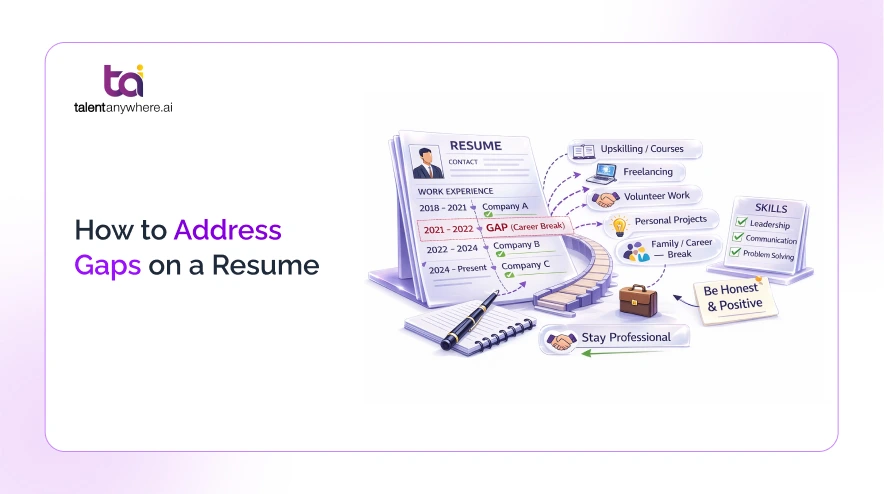
In your work experience section, you can also include a standard entry such as:
Career Break: 2022 – 2023
- Accomplished UX Design Certification
- Completed Freelance Client Projects
By doing this, you clearly show the reader how to put your Career Gap on your resume in an upfront manner, without trying to hide it.
Managed freelance client projects
You can also include Freelance or Project Work you did during your Career Gap as follows:
- Independent Consultant: 2022 – 2023
This gives the appearance that you stayed active while being engaged in working on a freelance basis.
Read More: Beginner to Expert: The Right Way to Present Skill Levels on Your Resume 🔥
Good Reasons for Gaps in Employment (With Sample Statements)
Context and self-Assurance are important when explaining employment gaps. Below, you’ll find examples of valid explanations for employment gaps, as well as samples you may modify to describe them in your resume.
Family Care
Numerous professionals have temporarily left the workforce to care for children, parents, or address a family emergency. Employers typically recognize that this is both a rational and reasonable life choice.
Example statement:
“Career break taken in order to manage family responsibilities while continuing to develop professionally via online courses.”
Health Recovery
A work gap that occurred because of a medical recovery is a valid reason for an employment gap. The only thing employers need from someone in this situation is assurance that they are now fit and ready to return to the workplace.
Example statement:
“Took a temporary career break due to recovering from a medical condition. Fully recovered and ready to return to my full-time professional responsibilities.”
Education
Education, whether it be college or certification, or preparation for a professional license or exam, illustrates ambition and established long-term business objectives as opposed to having been idle.
Example statement:
“Devoted this period to completing an MBA degree with a concentration in strategic leadership and companies.
Consultant/Freelance
When consulting or being self-employed as a consultant, it does not have to be considered a gap in employment if worded and presented properly, reflecting initiative and actual real-world experience.
Example statement:
“Provided consulting services to small businesses and startups in the areas of digital marketing.”
Start-Up Experience
Starting or being a co-founder of a new company develops resilience, leadership abilities, and problem-solving skills, regardless of whether the startup was successful or not.
For Example:
“Co-founded a start-up, and gained real-life experience developing new products, managing a company, and bringing on clients.”
Laid Off
When a person is laid off due to reorganization, slow sales, or downsizing of the whole company, that is usually not a reflection of the person or their job performance.
For Example:
“My job position was eliminated as part of the company’s plan to downsize, due to reorganization.”
Good Reasons for Gaps in Employment Sample
Using this format can help when explaining to future employers why there are gaps in a person’s employment history:
Reason for the Gap + Skill Development + Now Ready to Work Again
For Example:
“Took care of a sick relative while completing the Human Resource Analytics Certificate and am now looking for a full-time human resource position.”
Sample Resume with Gaps in Employment (Real Examples)
Here are templates for resumes with employment gaps (real-world illustrations):
Sample Resume Pattern for an Employment Gap (6 Month Interval)
Professional Overview
An Operational Executive with five or more years of operational experience. Recently completed Six Sigma Certification.
Recent Experience
- Operations Manager: 2019 – 2023
Career Gap of 6 Months
- Completed Lean Six Sigma Green Belt Certification
- Consulted two small to medium-sized Employers
This is a good example of a sample resume for employment gaps with shorter periods of time.
Sample Resume for Employment Gap (Greater than Two-Year Career Gap)
Summary Of Experience:
Human Resources Professional (Returning To Work After Caregiving)
Recent Experience:
- Human Resources Manager, 2015-2022
Career Gap 2022-2023
- Completed HR Analytics Certification
- Led Volunteer Recruitment/ Initiatives
This is a good sample resume for employment gaps with longer time spans.
Samples of Resumes with Employment Gaps: Pre-Optimization and Post-Optimization
Pre-Optimization, 2020-2023 (Nothing Listed)
Post-Optimization, Career Gap, 2020-2023
- Completed Product Management Certification
- Created three portfolio projects
The optimized resume for employment gaps helps reduce recruiters’ doubts regarding background checks.
Best Resume Format for Employment Gap
Utilizing a suitable resume format has the ability to help lessen the impact of employment gaps on your resume; each format has advantages and disadvantages that will assist you in determining the best choice for your personal situation.
Functional Resume
The functional resume format focuses on your skills/competencies, rather than a strict chronological timeline of your work experience.
Pros:
- Your transferable skills are highlighted rather than the dates you worked on.
- Long gaps in your work history will be minimized.
- This format will work great for individuals who are looking to change careers or for those who have a non-linear work history.
Cons:
- Some recruiters do not trust the functional format due to the lack of a clear timeline.
- ATS systems may favor chronological formatting.
- There may be questions about your work history, as the work history may not have been summarized clearly.
Best for: Long-term employment gaps, career transitions, or re-entering the workforce after a lengthy absence.
Hybrid Resume
The hybrid resume combines the benefits of a skills-based format with a structured timeline of your work history. You can build your hybrid resume today with the help of online platforms like talentanywhere.ai It’s free and makes sure that your resume passes through ATS software.
Pros:
- Combines both skills and the ability to see your timeline.
- Reduce emphasis on any gaps while maintaining your credibility.
- If formatted correctly, it will help match ATS systems.
Cons:
- If not carefully edited, it can result in excessive length.
- The overall structure of the resume must be well thought out to avoid repetition.
- Will still display boot time gaps at some level, although it remains neutral.
Best suited for: Professionals who are re-entering the workforce or candidates who have a moderate length of unemployment gap.
Skills-Based Resume
A skill-based resume emphasizes skills, achievements, and experience gained from projects completed instead of experience gained through formal placement in a job.
Pros:
- Focus on quantifiable results through the successful performance of measurable skills and competencies.
- Useful for freelancers, consultants, and project-based employees who have gaps in traditional employment or are not engaged in traditional employment relationships.
- Decreased emphasis/importance on traditional employment and resumes.
Cons:
- Lack of a clear timeline from previous employers on the resume creates questions of credibility with prospective employers.
- Not usually favored/accepted as a way of presenting resumes by more traditional industries.
- Requires a portfolio or other documentation of accomplished results to substantiate the claim of competent employment.
Best for: Freelancers, start-up business founders, independent contractors/consultants.
How to Explain an Employment Gap in an Interview
Your three-part framework for discussing an employment gap is this:
- Reason: A brief explanation of why you had an employment gap.
- Skill/learning: What you learned and/or skills you gained from that gap.
- Future focused: Why are you now the best candidate for the job you’re applying for.
Example interview answer: “I took a year off in order to care for a family member. While I was caring for my family, I completed my advanced Excel and data analytics certifications. I’m excited to apply those skills to a growth-oriented company.”
When you go to the interview, be confident when discussing the gap and what you’ve learned from it, as opposed to worrying about being perfect.
Read More: Best Resume Formats of 2026 🔥
Mistakes to Avoid When Addressing Employment Gap
When describing an employment gap in your resume, it’s just as important to be mindful of how you present the reason for the gap as it is to be honest about the reason for the gap. To avoid common pitfalls when addressing employment gaps:
Hiding Dates
If you try to hide the dates of your employment by removing months from the list or leaving jobs altogether or not providing dates of employment altogether, there is a strong chance that a recruiter will be suspicious. Most recruiters will check the timeline that you provide, and if they discover that you have removed information, there will be even more questions than there would have if you had not provided that information.
Lying about Employment History
If you fabricate dates of employment or create a fictitious job in your resume, you are likely to have serious issues during a background check. Employers value honesty above all and trust you more when you own up to a gap in employment.
Providing Too Much Detail in Your Explanation of Employment Gaps
Providing too much personal information regarding your time away from work makes your resume appear to be read as defensive instead of professional.
Placing Blame on Previous Employers
If you speak negatively about previous employers or layoffs, it may show that you are unprofessional and unwilling to accept responsibility for your past. You must remain neutral and focused when describing an employment gap.
Using Negative Terms/or Apology Words
When describing an employment gap, you do not want to use negative terms such as “I had no choice” or “unfortunately.” You need to be confident when describing an employment gap and speaking positively about what you have learned or gained from that time.
Create a Resume That Explains Your Career Gap Professionally
A well-thought-out resume will increase your chances of successfully finding employment after being out of the workforce for an extended period of time. Using the right tools to create a professional resume can help you confidently display your experience.
AI-Powered Resume Builder
An AI-powered resume builder is capable of suggesting ways to write about your employment gaps and highlighting your transferable skills through the way you format your professional experience on your resume. An AI- powered online free resume builder can help you formulate your work experience and present the employment gap in a positive manner while providing you with an optimized version of your resume based on the job description you wish to apply for.
Gap-Focused Templates
Templates are specifically designed to minimize the emphasis on the gap on your resume, rather than showcase your accomplishments, skills, or projects; therefore, ensuring the employer perceives your gap in employment as intentional and organized, rather than simply as a gap in your history.
ATS-Optimized Resume
Applicant Tracking Systems will evaluate your resume according to the keywords you have used within your resume, as well as how well your resume format matches the job description. Optimizing your resume so that it meets the requirements of ATS will improve your chances of being seen by a potential employer and will rank your resume higher in search results.
Conclusion
Employment gaps are common. Employers care more about skills, clarity, and honesty than perfect continuity. Learning how to explain a gap in a resume properly can turn a potential weakness into a professional strength.
With the right structure, wording, and confidence, your employment gap becomes part of your growth story, not a setback. And with smart tools like talentanywhere.ai, you can structure, optimize, and present your resume in a way that highlights your strengths while professionally addressing any career gaps. Start Building Your Resume Today.
FAQs
How long is the employment gap too long?
Should I put years or months on my resume?
Do short gaps matter?
How old employment gaps can be ignored?
Can ATS reject resumes with employment gaps?
Should I mention every career gap in resumes?
talentanywhere.ai Blog
Build professional resumes with AI, improve your ATS score, and apply with confidence. talentanywhere.ai empowers job seekers with smarter resume creation and career tools for every stage.